Disclaimer — This article is provided as general logistics industry knowledge and practical reference only. It does not constitute aviation safety, dangerous goods carriage, legal, tax or other professional advice. Actual transport, declaration, packaging, loading and customs requirements are subject to the carrier, competent authorities, official regulations and professional advice.
The feature of the B747F that fascinates project logistics professionals the most is the nose door. It allows certain oversized and over-length cargo—which cannot be maneuvered through the side doors—to be loaded directly onto the main deck from the front of the aircraft.However, the nose door is not a magic solution: height, angle, cargo base, floor load capacity, latches, shims, ground equipment, and trim—if any one of these factors is not met, loading may fail.
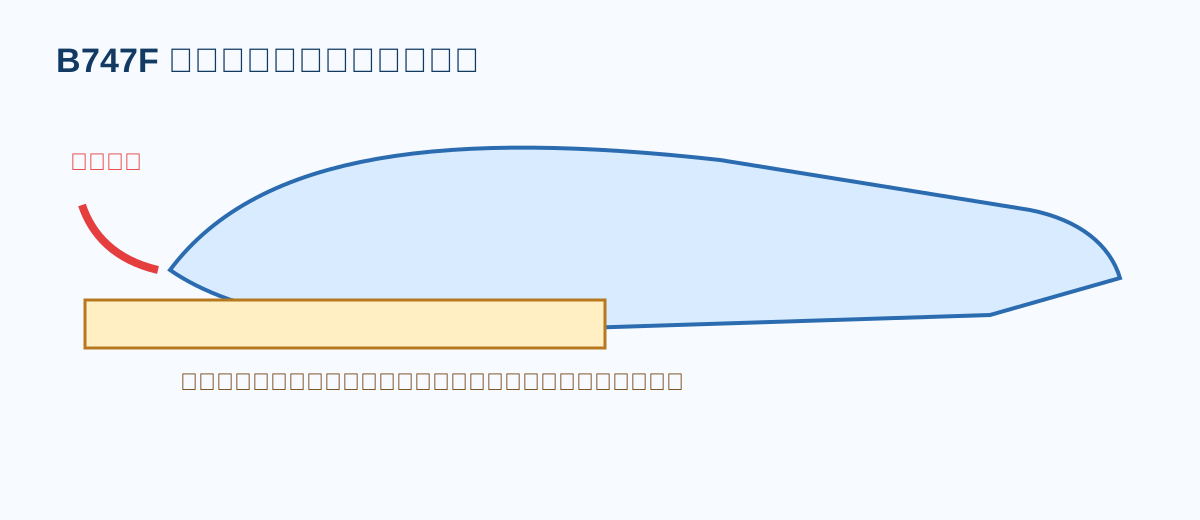
Schematic of B747F Nose Door Loading
What Problem Does the B747 Nose Door Actually Solve?
Most standard all-cargo aircraft are loaded through side cargo doors. Side-door loading has a natural limitation: after cargo enters the cargo door, it must be turned, positioned, and pushed into the cargo hold. For extra-long cargo, rigid long items, and irregularly shaped equipment, the turning radius and entry angle may be even more critical than the cargo’s length, width, and height.
The advantage of the B747F’s nose door is that cargo can enter the main deck from the front of the aircraft, resulting in a loading path that is nearly straight. This is particularly important for extra-long cargo.
Loading Methods
Advantages
Limitations
Side-Door Loading
Conventional, highly efficient, suitable for most cargo
Extra-long cargo requires turning, posing a high risk of exceeding dimensional limits
Front-loading
Suitable for certain extra-long straight items and oversized cargo
Still subject to height, profile, floor, and equipment restrictions
Belly Loading
Suitable for standard ULDs/bulk cargo
Limited capacity for oversized and extra-long cargo
Therefore, the significance of the B747 nose door is not that it is “larger,” but that it provides a “smoother access path.”
What types of cargo are best suited for the B747 nose door?
Cargo Type
Why the Nose Door Is a Good Option
Long industrial equipment
Long in length; difficult to maneuver through the side door
Aircraft Engines/Fuselage Components
Large in size, weight, and value
Oil and Gas Equipment
Heavy, large, and with tight delivery schedules
Rail transit components
High in length and rigidity
Molds/Machine Bases
Sensitive to Center of Gravity and Contact Area
Rescue/Emergency Project Cargo
Time-sensitive; willing to cover charter flight costs
However, “worth considering” does not guarantee successful loading. Many cargo items may appear to fit through the nose door in terms of length, but may still fail due to unsuitable height, width, packaging base, or lifting method.
Six Questions to Determine Whether Loading Through the Nose Door Is Possible
Question
Why It Matters
What are the cargo’s maximum external dimensions?
Must include packaging, base, lifting points, and protrusions
What is the structure of the cargo’s base?
This affects roller conveyors, forklifts, pallets, and load distribution
Where is the cargo’s center of gravity?
This affects lifting, maneuvering, and cargo hold positioning
Can the cargo tilt or rotate?
Some critical cargo requires angled access
Is specialized loading and unloading equipment required?
Standard high-lift equipment may not be sufficient
Can the cargo be unloaded in the same manner at the port of destination?
Just because cargo can be loaded at the port of origin doesn’t mean it can be unloaded at the port of destination
Project cargo is particularly vulnerable when only the “longest side” is provided. For example, a client might specify a length of 12 meters, but in reality, there are also wooden crate frames, lifting lugs, base legs, and surfaces that cannot be compressed. Loading assessments must be based on the maximum external dimensions, not just the equipment itself.
Loading through the nose door requires considering not just the door itself, but also the cargo hold’s profile
When the B747’s nose door is opened, cargo enters the main deck; however, the main deck is not an infinitely large rectangular prism. The fuselage’s circular cross-section causes it to taper upward on both sides, meaning that the taller the cargo, the narrower the allowable width.
Assessment Criteria
Practical Implications
Cargo Door Clear Opening
Determines whether entry is possible
Main Deck Contour
Determines whether items can be placed inside after entry
Rolling bed inside the hold
Determines movement and positioning
Latch positions
Determines whether ULDs/cargo can be secured
Floor load capacity
Determines whether the weight can be distributed to the corresponding area
Safety Margin
Determines whether there is sufficient operational margin
This is why airlines require loading diagrams. It’s not just a formality; it’s to see the actual location of the cargo inside the aircraft.
Would a failed latch affect loading?
Yes. Latches, roller bars, side rails, mesh panels, and tie-down points are all part of the cargo restraint system. Air transport isn’t just a matter of “putting it in”; cargo must be effectively restrained during flight and must not move, slide, tip over, or collide with the aircraft structure.
Latch Status
Possible Outcomes
Normal and Operational
Can be secured as planned
Individual latch failure
Depends on MEL/operational restrictions and load position
Multiple critical latches failed
May result in a change to the loading plan or refusal to load
Latch positions do not match the cargo
Requires redesign of the securing method
Freight forwarders are not required to determine whether a specific lashing is airworthy, but they must understand that when an airline states a lashing issue affects loading, it is not necessarily making an excuse. Any issue that compromises the securing capability may affect flight safety.
B747 Nose Door Loading Procedure
Stage
Action
Freight Forwarder/Client Must Prepare
1. Preliminary Assessment
Determine whether the cargo requires nose door loading
Dimensions, weight, photos
2. Loading Simulation
Airline/engineering assessment of access routes
CAD drawings, packaging diagrams, center of gravity
3. Ground Equipment Confirmation
High-load loading, towing, rolling racks, forklifts
Equipment Requirements and Airport Capacity
4. Test Fitting/Trial Assembly
Critical cargo verification path
Cargo or Mock-up Timing
5. Loading onto the aircraft
Nose door opening, cargo push-in, and securing
On-site Coordination and Safety Zone
6. Trim and Release
Airline load and balance check
Final weight and positioning
For oversized cargo shipments, it is best to schedule an on-site pre-inspection. If protrusions on the packaging base are discovered only after the flight has arrived, there is generally no time to make corrections.
Common Misconceptions About Nose Door Loading
Misconception 1: The 747 nose door can accommodate all oversized cargo.
This still depends on height, dimensions, weight, the base, and loading/unloading equipment.
Misconception 2: As long as it can be loaded at the port of origin, it’s fine.
The destination port must also have equivalent unloading and transshipment capabilities.
Misconception 3: Lashing is just a minor issue.
Lashing is critical to cargo restraint and flight safety.
Misconception 4: The sturdier the packaging, the better.
Packaging that is too large, too tall, or has an ill-designed base may actually prevent it from being loaded.
Misconception 5: Chartering a nose-loader is always cheaper than unpacking the cargo.
Sometimes, breaking down the shipment, repackaging it, or using combined sea-and-air transport is more cost-effective.
Customer-provided documentation list
[ ] Three-view drawings or CAD drawings for each piece of cargo
[ ] Maximum external dimensions including packaging
[ ] Gross weight per piece and total weight
[ ] Center of gravity, lifting points, and forklift slots
[ ] Photos of the packaging base structure
[ ] Whether the item can be tilted, rotated, or disassembled
[ ] Whether it is a hazardous material, contains live electrical components, or has residual oil or fluid
[ ] Lifting and truck loading conditions at origin and destination
How OneCargoKit Assists with Preliminary Assessment
Final confirmation of nose-loading must be provided by the airline, but preliminary screening can be performed using tools:
Case Study: Why Long Cargo Can’t Pass Through the Side Door but Might Fit Through the Nose Door
Suppose a piece of industrial equipment is 10.8 meters long, 1.9 meters wide, and 1.7 meters high, with a single-piece weight of 4.8 metric tons.On paper, its height and width are not excessive, and many would assume that a standard main-deck cargo aircraft with a side door could handle it. But the problem lies in its length. After entering through the side door, the cargo must be turned. If the equipment is a rigid, long item that cannot be bent or tilted at a steep angle, it may get stuck between the cargo door and the aisle inside the hold.
This is where the value of the B747F’s nose door becomes apparent: it allows cargo to enter the main deck in a straight line from the front, reducing the need for turning maneuvers. However, this still only represents a “possibility,” not a “guarantee” of successful loading.
Decision Points
Risks of Side-Door Freighters
Advantages of the B747 Nose Door
Entry Path
Requires turning
Closer to a straight-line approach
Rigidity of Long Cargo
Difficult to turn
Less need for steering
Operating space
Limited by the door opening
More operating space in front
Loading costs
May require repeated trial loading
A more straightforward solution
However, if the cargo height exceeds the nose door or the main deck’s available clearance, or if the base’s contact area is too small, posing a floor load risk, the nose door solution will not resolve the issue.
Key Points for Client Communication Regarding the Nose Door Solution
Customers are often only concerned with “Can the 747 fly? How much does it cost?” Freight forwarders should steer the conversation back to four key questions:
Why does this shipment require the nose door?
Is it due to length, angle, width, or height, or because the cargo cannot be loaded through the side door?
Are there any alternative solutions?
Is it feasible to split the shipment, repackage it, use sea-air multimodal transport, change the airport, or switch aircraft types?
Can operations be handled at both the origin and destination ports?
It’s not enough to just verify loading at the port of origin; unloading at the port of destination is equally critical.
How much is the customer willing to pay for certainty?
Charter flights are typically expensive and must be evaluated in conjunction with cargo value, downtime losses, and project default risks.
Customer Concerns
Professional Response
Why must it be a 747?
Due to access routes and strict cargo constraints—it’s not simply a matter of choosing a larger aircraft.
Can you make it cheaper?
We can evaluate alternative options, but risks and transit times must be considered together
Can you guarantee it will be loaded?
We can conduct a technical verification, but the final decision rests with the airline’s loading and clearance procedures
Why do you need so much documentation?
The more complete the documentation, the lower the probability of installation failure
On-site risks associated with nose-door installation
Risks
Description
Mismatch between the cargo base and the roller bed
Difficulty in loading or damage to packaging
Insufficient operating space ahead
Restricted access to the nose gate and limited cargo alignment
Shift in the load’s center of gravity
Possible instability during movement
Last-minute changes to the package
Original plan no longer viable
Weather and apron conditions
Rain, snow, and wind may affect operational safety
Lack of unloading equipment at the destination port
Cargo cannot be unloaded normally upon arrival
Loading through the nose door is an engineered operation—it is not simply a matter of “opening the door and pushing the cargo in.” The more critical the cargo, the more essential it is to complete verification prior to the flight.
Nose-door loading must be considered during the packaging design phase
Many issues with oversized cargo projects are not actually due to the aircraft, but rather to packaging. To protect their equipment, manufacturers often add large wooden crates, steel frames, shock-absorbing supports, and lifting lugs to the exterior. While this is usually fine for ocean freight, every centimeter counts in air freight.Even if the equipment itself could originally fit through the nose door, if the height or width exceeds the limits after packaging, the project will incur entirely different costs.
Packaging Details
Impact on Nose-Gate Loading
Anti-vibration Frames
Increase in Overall Dimensions
Base Feet
Increased Height and Point Loads
Protruding Lifting Ears
May cause door jamming or exceed clearance limits
Crate thickness
Affects height, width, and weight
Irregular shape
Increases the difficulty of securing and handling
Therefore, if air freight is a possibility for project cargo, it is best to involve the freight forwarder and the airline’s technical representatives during the packaging design phase. Do not wait until the wooden crate is built and the cargo arrives at the airport to discover that “the equipment itself can fly, but the packaging cannot.”
How to Evaluate Alternatives for Nose-Loaded Cargo
Not all oversized cargo must be loaded through the nose door of a B747. Alternative options include disassembling the equipment, modifying the packaging, using the side door of a B777F, combined sea-air transport, changing the destination port, or switching to fast ocean freight.
Solutions
Advantages
Costs
B747 Nose Door
Fast transit time, suitable for long cargo
High cost, limited resources
Split cargo
Reduces loading difficulty
Assembly costs at the factory and destination
Repackaging
May be suitable for standard cargo aircraft
Requires time and engineering verification
Sea-air intermodal transport
Lower cost
Delivery times are not as fast as all-air freight
Sea Freight
Lowest cost
Longer transit time
Professional advice isn’t always to recommend the most expensive aircraft type, but rather to help clients compare transit times, risks, and costs. What clients are really buying isn’t the aircraft—it’s the on-time completion of their project.
How to Apply This Article to Actual Quotes
When dealing with cargo that may require a B747 nose door, do not limit your quote to just the “charter rate.”We recommend breaking down the quote into three tiers: the first tier is the budget estimate, which helps the client determine whether air freight is a viable option; the second tier is the technical confirmation quote, provided after the airline completes its loading assessment; and the third tier is the final execution quote, which includes fees for the airport, equipment, operations, documentation, and the destination port.
Quotation Levels
Applicable Stage
Description
Budget Quote
Initial client inquiry
Used only to gauge interest; no commitment to proceed
Technical Confirmation Price
Following airline evaluation
Takes into account aircraft type, doors, panels, and payload
Final execution price
After flight and resources are confirmed
Clearly state cancellation, standby, and change terms
If the customer is unwilling to provide drawings, photos, and packaging data, do not provide a quote that is too definitive. You may explicitly state: The price and feasibility of the nose door solution depend on the actual dimensions, weight, center of gravity, packaging base, ground equipment, and unloading conditions at the destination port. When information is incomplete, only a reference range can be provided.
Reminder for Exporters of Foreign Trade Equipment
If your product may require air freight for oversized cargo, it is best to consider packaging and loading arrangements during the contract phase.Many international trade contracts specify only the delivery date, without detailing the packaging dimensions, whether the item is disassemblable, or its suitability for air freight. It is often not until the client’s factory halts production and requests urgent air freight that issues arise—such as wooden crates exceeding height limits, bases that are too wide, unclear lifting points, or a lack of unloading equipment at the destination port—by which time the timeline has become extremely tight.
Equipment exporters can prepare an “Air Freight Emergency Information Package” at the start of the project: three-view drawings of the equipment, packaging diagrams, weight, center of gravity, lifting points, disassembly instructions, whether the equipment contains oil, fluids, batteries, or pressure vessels, and unloading conditions at the destination.It doesn’t matter if it’s not needed on a regular basis; once air freight becomes necessary, this set of documents can save one to two days of communication time.
Professional Summary
The value of the B747 nose door lies not in its “size,” but in providing a more direct access route for oversized cargo. It makes air transport possible for project cargo that many side-door cargo aircraft struggle to handle, but it is not a shortcut to bypass safety regulations.
A truly professional assessment considers the door, cargo hold, cargo panels, locking mechanisms, floor, equipment, weight and balance, and destination port as a unified whole. The sooner a client provides complete documentation, the more reliable the charter proposal will be; the more vague the information, the more the quote resembles a gamble.
This article is intended as industry knowledge and a practical reference; it does not constitute advice regarding aviation safety, loading engineering, or carrier liability. For specific B747F loading capacities, locking restrictions, and operational procedures, please refer to the airline, ground handling agent, and the aircraft type’s loading manual.