Disclaimer — This article is provided as general logistics industry knowledge and practical reference only. It does not constitute aviation safety, dangerous goods carriage, legal, tax or other professional advice. Actual transport, declaration, packaging, loading and customs requirements are subject to the carrier, competent authorities, official regulations and professional advice.
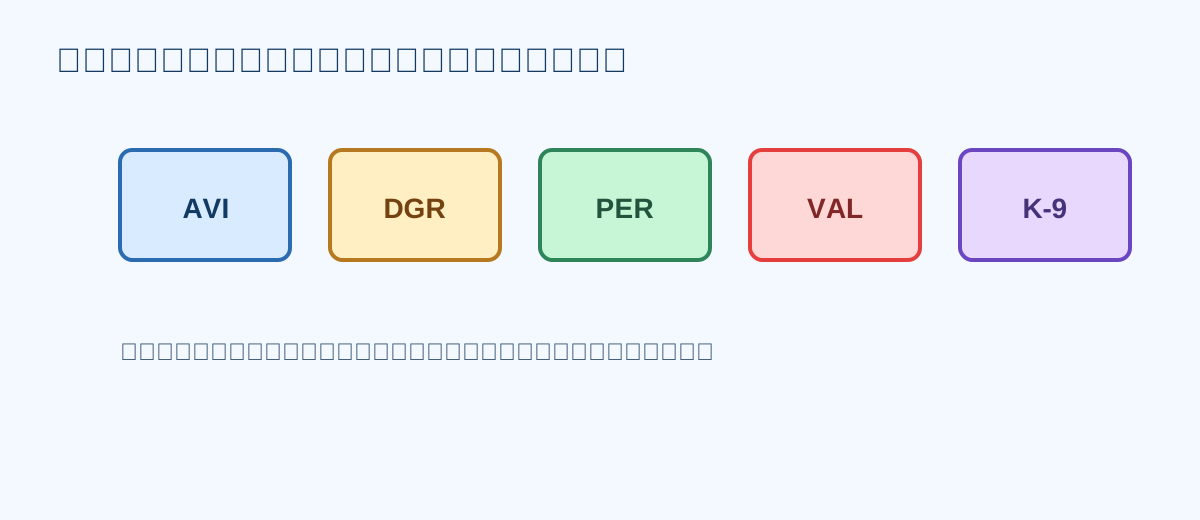
Air cargo codes aren’t just abbreviations meant to look good; they enable airlines, warehouses, security screening personnel, flight crews, and destination airports to identify risks using a common language.Terms like AVI, DGR, PER, VAL, HEA, HUM, MAG, and K-9 correspond to acceptance, security screening, isolation, temperature control, loading location, and handling of exceptional cargo, respectively.
Illustration of Air Special Cargo Codes
Why Are Special Cargo Codes Important?
While general cargo can be handled through standard procedures, special cargo requires a different operational pathway. The purpose of these codes is to communicate special requirements to all involved parties in advance.
Definitions may vary by airline; specific details are subject to the carrier’s rules and the IATA/TACT system.
What Does “K-9” Mean in Air Freight in Europe and the U.S.?
K-9 typically refers to canine security screening, which involves using trained dogs to screen cargo for explosives or prohibited items. In the air cargo security systems of Europe and the United States, K-9 is a common security screening method. It is not a cargo attribute code, but rather a concept related to the security screening method or status.
Items
K-9 Considerations
Purpose
Cargo Security Screening
Applicability
Certain air cargo, warehouse, and security monitoring scenarios
Impact
May affect cut-off times, warehouse operations, and costs
Common Misconceptions
It does not mean “anything can be shipped once it has been inspected by a dog”
When freight forwarders ship to Europe and the U.S., if the carrier mentions “K-9 cut-off,” “K-9 screened,” or “K-9 fee,” it refers to air security inspections. Specific requirements are subject to local regulations, carrier policies, and warehouse arrangements.
How Do Special Cargo Codes Affect Booking?
Special Cargo
Confirm Before Booking
Dangerous Goods
UN number, DGD, packaging class, and whether the airline accepts it
Live Animals
IATA LAR, health certificate, containers, route
Temperature-Controlled
Temperature Zone, Packaging, Cold Storage, Dry Ice
Cutoff times, direct flights, pickup at destination port
Magnetic
Magnetic inspection reports and airline restrictions
Special cargo cannot be booked as general cargo first and then have the code added later when the shipment is due. Many types of special cargo require advance approval from the airline.
Checklist-Based Approach: The Core of Special Cargo Operations
Checklists are essential for handling special cargo. The human brain cannot remember every detail, and checklists help prevent oversights.
Checklist Items
Example
Cargo Attributes
Is it DGR, AVI, PER, VAL, or MAG?
Documents
DGD, health certificate, temperature control instructions, magnetic inspection report
Packaging
Dangerous Goods Packaging, Live Animal Containers, Cold Chain Packaging
Labeling
UN labels, directional labels, temperature control labels
Airline Approval
Confirmation of Acceptance Received
Security Screening
X-ray, ETD, K-9, Manual Inspection
Loading
Segregation, temperature-controlled areas, heavy cargo locations
The more specialized the cargo, the less one can rely on a veteran handler’s “memory.” The inspection checklist is not a rudimentary tool; it is a safety net for high-risk operations.
Process for Special Cargo from Inquiry to Loading
Stage
Action
Risks
1. Identification
Determine whether the cargo is special
Description is too broad
2. Documentation
Collect certificates, declarations, and reports
Documentation does not match
3. Booking
Explain the code and requirements to the airline
Concealment of characteristics
4. Packaging
Pack and label according to regulations
Labeling errors
5. Security Screening
Screening in accordance with local regulations
Insufficient cutoff time
6. Pickup and Transport
Airline/GHA Acceptance
Discrepancies between documentation and actual cargo
7. Loading
Quarantine, temperature control, center of gravity
Position Restrictions
8. Port of Destination
Customs clearance, cargo pickup, and handover
Agent not familiar with the process
If special cargo involves chargeable weight and surcharges, use OneCargoKit’s Chargeable Weight Calculator and Surcharge Calculator for internal accounting. Special cargo typically incurs more than just the base freight rate.
What is the difference between K-9, X-ray, and ETD?
Security Screening Methods
Layman’s Terms
Common Impacts
X-ray
Inspection via imaging equipment
Large items may not fit through the machine
ETD
Trace Explosive Detection
Sampling required
K-9
Canine Sniffer Screening
Must comply with local security procedures
Manual Inspection
Unpacking or on-site inspection
May affect the integrity of the packaging
The specific method used is not at the freight forwarder’s discretion; it depends on local aviation security requirements, the nature of the cargo, warehouse capacity, and carrier regulations.
Common Misconceptions
Misconception 1: The special cargo code is merely a system note.
It affects acceptance, security screening, loading, and handling at the destination port.
Misconception 2: K-9 is a cargo code.
“K-9” more commonly refers to a security screening method or status, not a cargo attribute.
Misconception 3: Dangerous goods can be classified under general commodity names to reduce risk.
Incorrectly declaring dangerous goods poses a serious risk.
Misconception 4: Live animals, perishables, and temperature-controlled cargo are merely a matter of transit time.
They also involve packaging, temperature, care, and the capacity of the destination port.
Misconception 5: Inspection forms are only for new employees.
High-risk shipments require checklists even more.
Special Cargo Checklist
[ ] Have the cargo attributes been identified?
[ ] Does the special cargo code match the actual cargo?
[ ] Are all documents, reports, and certificates complete?
[ ] Are the packaging and labeling in compliance with requirements?
[ ] Has the airline accepted and confirmed the shipment?
[ ] Are the security screening method and cut-off time clearly specified?
[ ] Have the stowage segregation, temperature control, and heavy cargo placement been confirmed?
[ ] Can the agent at the destination port handle this type of cargo?
[ ] Are exceptional charges and liability limits clearly specified?
An anomaly caused by a missing code
A shipment actually contained magnetic materials, but was declared only as general mechanical parts at the time of booking. Upon arrival at the airport, security screening detected an anomaly and required a magnetic inspection report and reconfirmation of carriage. Due to insufficient time before the cut-off, the shipment missed its original flight. The client blamed the freight forwarder for the delay, while the forwarder claimed the client failed to declare the materials, leading to a dispute.
If MAG-related logic had been used to identify the cargo from the outset, magnetic testing documentation would have been requested during the inquiry stage, and the airline could have determined in advance whether to accept the shipment.
Omissions/Errors
Possible Consequences
Omission of DGR
Incorrect declaration of dangerous goods; severe risk
Omission of AVI
Live animals without proper care; may be refused
Omission of PER
Perishable goods not given priority handling
VAL not provided
Insufficient security and handover procedures
MAG not entered
Delays due to security screening and missing documentation
HEA: Omission
No load assessment performed for heavy cargo
Special cargo codes are essentially a risk mitigation measure; they are not optional remarks within the system.
How to Foster Code Awareness Within Freight Forwarding Companies
Job Roles
Responsibilities
Sales
Identify special cargo attributes during inquiries
Operations
Accurately convey codes and requirements when booking space
Warehouse
Verify labels, packaging, and documents upon receipt
Finance
Account for special cargo fees separately
Customer Service
Be able to explain the handling rules corresponding to error codes when anomalies occur
A mature air freight team identifies special cargo during the quotation stage, rather than waiting for it to be discovered at the airport.
Key Communication Points Regarding K-9
Under aviation security regulations in Europe and the U.S., K-9 procedures may affect cut-off times and fees. If a customer asks why there is an additional K-9 fee, explain:
This is a fee or procedure related to airline security screening, not a charge for the shipment itself. Whether it applies depends on local regulations, the warehouse, the carrier, and the nature of the cargo. It may affect delivery deadlines, so advance planning is necessary.
K-9-Related Questions
Suggested Responses
Can this be waived?
Subject to local security requirements
If I go through the screening, is boarding guaranteed?
This refers only to the security screening process and does not constitute a guarantee of carriage
Why do I need to drop off my luggage early?
K-9/security screening requires a specific time window
Is this available for every shipment?
It depends on the airport, carrier, cargo, and regulatory requirements
How is the inspection checklist implemented?
We recommend creating a separate checklist page for each shipment of special cargo, which should include at least the following: cargo attributes, codes, documentation, packaging, labeling, airline approvals, security screening methods, destination port handling, and fee exclusions.
It is best to keep the checklist together with the AWB, booking confirmation, and warehouse receipt. This way, if an issue arises, the team can quickly pinpoint the problem rather than having to search through group chat logs.
Relationship Between Special Cargo Codes and the AWB
The “Handling Information,” description of goods, number of pieces and weight, special cargo code, and related documents on the AWB must all be consistent with one another. If the code lists “DGR” but lacks “DGD”; if the description states “general electronics” but the shipment actually contains lithium batteries; or if “PER” is listed but there are no temperature control or time-sensitive arrangements—these discrepancies can all lead to subsequent risks.
Documents/Fields
Items That Must Match
AWB Description
Must match the actual cargo
Special Cargo Code
Must match the cargo attributes
DGD/Declaration
Matches the dangerous goods code
Label
Consistent with declaration and packaging
Booking Confirmation
Consistent with the airline’s acceptance conditions
Warehouse Receipt Record
Consistent with the actual goods
The biggest concern with special cargo is when “the system records one set of details, but the actual cargo is another.” If security, the airline, or regulatory authorities discover any discrepancies, the consequences range from delays to refusal of carriage and penalties.
The Recommended Order for Newcomers to Learn Special Cargo Codes
Don’t try to memorize all the codes right away. It’s recommended to first learn the logic behind DGR, batteries, and dangerous goods; then move on to AVI, PER, VAL, HUM, HEA, and MAG; next, study specialized procedures for cold chain, pharmaceuticals, valuables, human remains, and live animals; and finally, learn about local variations across different airlines and airports.
The codes themselves aren’t difficult; the challenge lies in the operational requirements behind them. When you see “DGR,” think of documentation and labeling; when you see “AVI,” think of containers and quarantine; when you see “PER,” think of time sensitivity and temperature control; when you see “HEA,” think of floor load and dunnage.
How Special Cargo Codes Affect Pricing and Transit Times
Special cargo typically incurs additional costs and requires earlier cutoff times. Dangerous goods require document review and label inspection; live animals require containers and care; perishables require priority handling; high-value cargo requires security measures; and K-9 or other security screenings may increase wait times and fees.
Codes/Processes
Impact on Quotes
Impact on Transit Times
DGR
Dangerous goods handling fees, documentation fees
Earlier cutoff
AVI
Live Animal Handling Fee, Care Fee
Stricter route selection
PER
Priority processing, cold storage
Cannot wait for extended periods
VAL
Security and Handover
More Cautious Procedures
K-9
Security Screening Fees
Allow time for screening
HEA
Pads and Equipment
Slower Loading and Unloading
Therefore, quotes for special cargo cannot be based on standard cargo rates. If a customer insists on standard cargo rates, risks typically surface during the airport handling process.
Why Should Customers Proactively Declare Special Attributes?
Some customers worry that disclosing attributes such as batteries, magnetic materials, liquids, powders, or valuables will result in higher rates, so they provide vague descriptions of the goods. This practice is extremely dangerous. Special attributes are not a matter of price, but of safety and regulatory compliance.
By proactively declaring these attributes, freight forwarders can identify suitable airlines, prepare documentation, and arrange security screening and loading in advance. Concealing these attributes, however, can result—if discovered—in delays at best, and at worst, refusal of carriage, fines, account suspension, or even the termination of future business relationships.
Truly professional clients treat special attributes as part of the shipment documentation rather than hiding them.
How to Conduct Training on Special Cargo
We recommend that freight forwarders select a few real-world cases each month for review: Why was a DGD supplement required for this shipment? Why was the K-9 cutoff earlier for this shipment? Why couldn’t this AVI shipment be routed via a transit point? Why did this HEA shipment require additional dunnage? Real-world cases are more effective than simply memorizing codes.
Training Content
Objectives
Code Meanings
Identify Risks First
Document Requirements
Know what to request from the client
Packaging labels
Know what the warehouse checks for
Airline Restrictions
Know when to upgrade
Exception Cases
Building a Knowledge Base
The ability to handle special cargo isn’t developed overnight. It requires salespeople who know how to ask the right questions, operations staff who know how to review shipments, warehouse staff who know how to inspect cargo, finance staff who know how to calculate costs, and customer service representatives who know how to explain the process.
One final practical tip
Risks can only be controlled once special cargo codes are identified. The more vague the customer information is, the more you need to ask follow-up questions; the more sensitive the cargo attributes are, the more you need to confirm them in advance. A truly professional air freight team won’t wait for the airport to discover problems.
Professional Summary
The value of air freight special cargo codes lies in ensuring that complex shipments are correctly identified through multi-party collaboration. Incorrect, omitted, or late entry of these codes will deprive subsequent operations of early warning signals.
Terms like K-9, AVI, DGR, PER, and VAL are not obscure industry codes, but rather the language of safety and operations. A truly professional freight forwarder doesn’t just memorize these codes; they understand the documentation, packaging, security screening, loading procedures, and liabilities associated with each one.
This article serves as an industry knowledge and practical reference and does not constitute advice regarding aviation security, dangerous goods, live animals, or carrier liability. For specific codes, security screening procedures, and carriage rules, please refer to airline policies, local regulations, IATA rules, and professional advice.