Disclaimer — This article is provided as general logistics industry knowledge and practical reference only. It does not constitute aviation safety, dangerous goods carriage, legal, tax or other professional advice. Actual transport, declaration, packaging, loading and customs requirements are subject to the carrier, competent authorities, official regulations and professional advice.
Chartering a flight isn’t as simple as “renting a plane if you have the money.”A true air charter is the result of a combination of factors: cargo profile, aircraft type selection, flight rights and schedules, airport support, loading plans, dangerous goods/special cargo documentation, ground equipment, and weight and balance clearance. Freight forwarders and project clients do not need to load the aircraft on behalf of the airline, but they must understand that failing to clarify certain issues in advance can result in significant costs once at the airport.
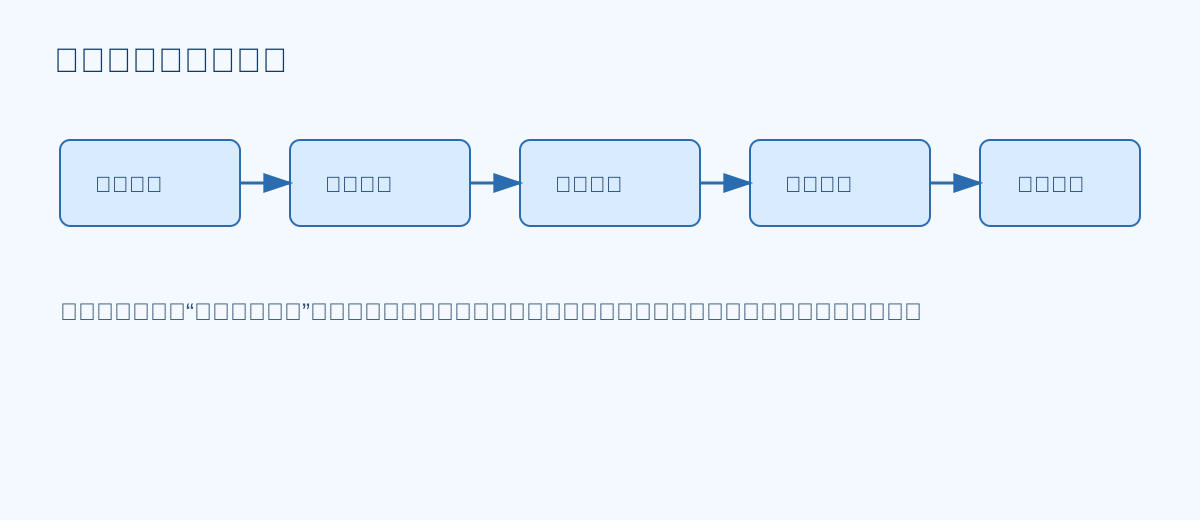
Key Steps in Air Charter Operations
Why Create the “Air Freighter Series: Practical Insights”
Standard air freight articles typically cover AWBs, billable weight, space booking, and customs clearance. But when it comes to charter flights, oversized cargo, heavy cargo, over-length cargo, live animals, temperature-controlled shipments, and dangerous goods, the challenges are entirely different.
When a client asks, “Can this shipment be transported via a chartered flight?”, a professional operator’s first instinct isn’t to provide a quote, but to assess:
Assessment Criteria
Why It’s Important
Common Mistakes
Cargo Dimensions
Determines whether the cargo can pass through the cargo door and navigate turns to enter the cargo hold
Only reporting length, width, and height, without specifying packaging or lifting points
Unit Weight
Determines floor load capacity, dunnage, and loading/unloading equipment
Only the total gross weight is considered; individual piece point loads are not considered
Cargo attributes
Determines whether the shipment is hazardous, live animals, temperature-controlled, or valuable
Item description is too vague
Departure and Arrival Airports
Determines air rights, flight schedules, runways, and ground support
Focusing only on cities, not on airport capacity
Aircraft type
Determines cargo doors, payload, range, and cargo hold profile
Only asks, “747 or 777?”
Time Window
Determines whether flights and ground resources can be scheduled
Last-minute cargo changes by the client
The goal of this series is to translate content traditionally focused on airlines, ground handling, and loading operations into practical decision-making tools for freight forwarders, project logistics professionals, exporters of foreign trade equipment, and sellers of oversized cross-border cargo.
The First Step in a Charter Inquiry: Creating a Cargo Profile
The worst thing you can hear in a charter inquiry is: “We have 80 metric tons of equipment to ship from Shanghai to Europe—how much does it cost?” This information is far from sufficient. A charter inquiry that can actually result in a quote must include, at a minimum, a complete cargo profile.
Information
Reason for Requirement
Remarks
Number of Pieces
Determines palletization, hold allocation, and ground operations
Oversized and loose cargo follow different handling logic
Single-piece dimensions
Determines cargo door and cargo hold profiles
Length, width, and height must include packaging
Gross weight per piece
determines floor load capacity and dunnage requirements
Do not provide only the gross weight
Center of gravity/lifting points
Determines loading and unloading safety
Especially important for heavy equipment
Stackability
Determines cargo hold utilization
Most Oversized Items Cannot Be Stacked
Whether it is a hazardous material
Determines the airline and required documentation
Batteries, chemicals, gases, etc.
Temperature-controlled or live animals
Determines aircraft type and cargo hold
Not all cargo holds are the same
Packaging materials
Determines securing, load-bearing capacity, and quarantine requirements
For wooden packaging, also check the destination country
If dimensions and units are mixed, you can first use OneCargoKit’s Unit Converter to standardize cm, inches, kg, and lb; if you need to make a preliminary assessment of volumetric weight, use the Chargeable Weight Calculator for an initial estimate.
Step 2: Don’t choose the most famous aircraft—choose the right aircraft type
Many customers immediately think of the B747 when they hear “charter flight.”The nose door of the B747F is indeed suitable for certain extra-long cargo items, but not every charter flight requires a 747. The B777F, B767F, B757F, A330F, and even narrow-body freighters all have their value in different scenarios.
Aircraft Type
Suitable Scenarios
Common Misconceptions
B747F/747-8F
Extra-long, extra-large, heavy cargo, or cargo requiring a nose door
High cost; not cost-effective for all cargo
B777F
Long range, high payload, mainstream international routes
No nose door; access angle for extra-long cargo depends on the side door
B767F
Medium-range, regional charter flights, express delivery, and e-commerce
Limited main deck space
B757F
Narrow-body freighters, regional trunk routes
Significant restrictions on oversized and high-volume cargo
A330F/modified aircraft
Medium- to long-range general cargo and e-commerce cargo
Specific capabilities depend on the airline and configuration
According to official Boeing data, the 777F is a long-range twin-engine freighter with a main deck capacity of 27 pallets;the 777-8F can accommodate 31 main deck pallets. The 767-300F, meanwhile, is positioned as a medium-sized wide-body freighter. In actual operations, aircraft selection depends on cargo doors, main deck height, range, payload, airport support, and cost.
Step 3: The Loading Plan Determines Whether a Charter Can Proceed
When quoting for a charter, the process does not start with a price and then figure out how to load the cargo; rather, the loading plan is established first, followed by price negotiations.
Loading Considerations
Corresponding Risks
Can the cargo fit through the cargo door?
If cargo cannot fit through the cargo door, the charter is pointless
Can the cargo be rotated inside the cargo hold?
This is especially important for side-door cargo aircraft
Is a loading ramp required?
Cargo that is oversized, irregularly shaped, or near the size limit must be verified
Does a single piece exceed the floor load limit?
Determining whether shims are needed or if the plan needs to be modified
Is the ULD airworthy?
Pallets, netting, and latches that do not meet standards cannot be loaded onto the aircraft
Determine if the aircraft can be balanced
Depends on the center of gravity, forward and aft cargo compartments, fuel, and range
Is temperature control or isolation required?
Special cargo must not be placed arbitrarily
This is why professional charter teams often ask clients to provide cargo drawings, packaging photos, center of gravity locations, slinging instructions, forklift holes, and base structures. This is not to cause trouble for the client, but to avoid discovering at the airport that the cargo cannot be loaded.
If ULD compatibility is a concern, you can use OneCargoKit’s ULD Calculator to perform a preliminary contour assessment. This tool is only for preliminary screening; the final determination must still be based on the airline’s, ground handler’s, and aircraft type’s loading manuals.
Step 4: Air Rights, Flight Schedules, and Airport Support
A charter flight cannot take off simply because the cargo is ready. Other factors must also be considered, including air rights, takeoff and landing times, airport curfews, runway conditions, parking stands, loading and unloading equipment, as well as customs and security resources.
Conditions
Impact
Air Rights
International charter flights must be legally authorized
Schedules
Determines whether departure can occur within the client’s time window
Airport Capacity
Availability of high-load and main-deck cargo aircraft support
Runway/Parking Bay
Can heavy-load cargo aircraft operate here?
Customs and Security Screening
Support for oversized cargo, dangerous goods, and nighttime operations
Port of Destination Agent
Can cargo be received, cleared, and transshipped?
Project cargo often gets stuck at the “destination port.” Even if the cargo is loaded at the port of origin, high costs can still arise if the destination port lacks the necessary equipment, customs clearance documents, or trucks.
Why a Charter Project Might Fall Through at the Last Minute
Suppose a client has a shipment of new energy equipment that needs to be flown from East China to a European factory within 72 hours. The sales representative was given a total weight of 65 metric tons and believed that either a B747F or a B777F could handle the job, so they provided the client with a rough quote.After the client confirmed the quote, the operations team discovered a problem: four of the main pieces of equipment were nearly at the side door’s length limit, had protruding support legs on their bases, and had a center of gravity shifted to the right; additionally, the wooden crates were fitted with external shock-absorbing frames, making their actual height 18 centimeters taller than the client’s initial measurement.Although the destination airport could accommodate cargo aircraft, it lacked high-load capacity loading equipment and low-bed transfer vehicles with sufficient tonnage.
The problem with this project wasn’t a “lack of aircraft,” but rather that the initial inquiry failed to establish a complete profile of the cargo.
Omissions in the Initial Inquiry
Back-End Consequences
Failure to inquire about individual item dimensions
Incorrect aircraft type determination
Failure to ask about protruding packaging elements
Inaccurate assessment of cargo door clearance and overall dimensions
Failure to inquire about the center of gravity
Increased risks during lifting and maneuvering
Failure to inquire about destination port equipment
Can’t be unloaded even if flown in
Failure to verify disassembly feasibility
There’s no time to change the packaging at the last minute
The costliest mistake in chartered flights is treating uncertainties as certainties during the quoting stage. Sales teams quote low prices to secure orders, but later, operations, airlines, and clients have to cover the shortfall together—resulting in either additional charges, rescheduling, or outright failure.
How Should Freight Forwarding Sales Reps Ask Clients?
Charter salespeople shouldn’t rush to ask, “What’s your budget?” A better way to ask is:
Questions to Avoid
More Professional Approach
How many metric tons?
What are the dimensions, weight, photos, and packaging method for each piece of cargo?
What type of aircraft do you need?
Does the cargo need to be loaded through the nose door, or is the side door an option?
When is the flight?
When will the cargo be ready, when will the documents be ready, and when can it be picked up at the airport?
From where to where?
Specific origin and destination airports—are alternate or nearby airports acceptable?
Is it general cargo?
Does it contain batteries, hazardous materials, temperature-controlled goods, live animals, oils or liquids, magnetic materials, or high-value items?
A well-crafted charter inquiry should allow the airline to determine in the first round whether it’s worth further evaluation. Vague inquiries will only make airlines reluctant to provide a quote or result in a very conservative, high price.
Which costs are commonly omitted from charter quotes?
Cost Items
Description
Aircraft Hourly Cost
The primary cost, but not the only one
Positioning/Ferry Flight Fees
May apply when the aircraft is not at the point of origin
Airport Landing, Takeoff, and Parking Fees
Vary significantly by airport
Ground handling fees
Loading, forklifts, personnel, and nighttime operations
Special cargo handling fees
Dangerous goods, live animals, temperature-controlled cargo, and valuable cargo
Loading engineering fees
Spreader plates, dunnage, and special securing solutions
Flight Rights and Schedule Costs
May be higher for ad hoc charter flights
Unloading and transshipment at the destination port
Often Overlooked
If you need to break down these costs for clients, you can use OneCargoKit’s Surcharge Calculator to generate an internal list of cost items. While it cannot replace an airline’s official quote, it helps sales teams avoid simply quoting a vague total price.
Common Misconceptions
Misconception 1: A charter flight guarantees that the flight will definitely take off.
Chartered flights provide greater control, but they are still subject to restrictions related to safety, air rights, airports, weather, documentation, and weight and balance.
Misconception 2: As long as the total weight isn’t exceeded, the cargo can be loaded.
For heavy cargo, airlines place greater emphasis on individual piece weight, contact area, and floor load capacity.
Misconception 3: A 747 can carry any oversized cargo.
The 747 has a powerful nose door, but it also has height, profile, floor, and operational restrictions.
Misconception 4: Get a quote first, then provide the details later.
Quoting a charter flight without a cargo profile carries significant risk.
Misconception 5: The destination port is just for receiving the cargo.
The port’s equipment, customs clearance, and trucking capacity determine whether the project can be successfully completed.
Charter Inquiry Checklist
[ ] Dimensions, weight, photos, and packaging method for each piece of cargo have been confirmed
[ ] Whether items are stackable and have lifting points/forklift holes
[ ] Is the cargo dangerous goods, battery-powered, temperature-controlled, live animals, or high-value?
[ ] Are there cargo aircraft support capabilities at the origin and destination airports?
[ ] Is a specific aircraft type required, such as a B747 nose door or B777F/B767F?
[ ] Are extension boards, dunnage, or specialized GSE required?
[ ] Can documentation, customs clearance, and permits be completed prior to the flight?
[ ] Have unloading and transshipment at the destination airport been arranged?
What each of the three roles should focus on
The biggest risk in a charter project is when everyone is “waiting for someone else to confirm.” Freight forwarder sales, operations, and the client’s project manager must each focus on their own key responsibilities.
Role
Should Monitor
Should Not Do
Sales
Scope of requirements, pricing terms, cancellation policies
To close the deal, promise that “it will definitely fly”
Cargo details, on-site delivery, pickup at destination port
Pass all issues on to the freight forwarder
Sales teams must understand that charter flight sales are not about selling a price per kilogram, but about selling project certainty.The sooner you include restrictions in the quote, the fewer disputes there will be later on. Operations staff must understand that charter flights are not simply an expanded version of regular bookings; any single detail can cause flight delays. Clients must also understand that charter projects require cooperation—it’s not enough to simply pay and wait for the plane to arrive.
I recommend creating a shared checklist for every charter project, which should include at least the cargo manifest, aircraft type proposal, airline confirmation, ground equipment, document status, payment status, delivery time, loading time, destination port contact, and contingency plans. The larger the project, the less you should rely on WeChat group chat logs for management.
The risk parameters for charter projects must be clearly stated upfront
Many disputes stem from the statement: “Didn’t you say the charter flight would go ahead?” A professional quote should clearly state that charter flight arrangements are typically subject to the following conditions: the actual cargo matches the information provided by the client;all documents, permits, and dangerous goods information must be complete and submitted on time; ground support must be available at both the origin and destination airports; air rights, flight schedules, weather conditions, and airport operations must be normal; the airline’s final loading, weight and balance, and release must be approved; and the client must deliver the cargo on time and complete payment.
These are not just standard disclaimer clauses, but the actual limitations of air charter operations. By clearly outlining these limitations, clients will not perceive you as unprofessional; rather, they will understand that you are not making empty promises.
Professional Summary
Air charter is not a price-based product, but a project-based endeavor. It ties together sales, operations, airlines, ground agents, customs clearance, trucking, and the client’s on-site operations.
A truly professional charter team won’t just ask “how many metric tons and where to,” but will follow up with the client to obtain dimensional drawings, packaging diagrams, center of gravity data, cargo properties, and destination port plans. This is because the greatest risk in chartering isn’t the lack of an aircraft, but rather the aircraft arriving only to find the cargo cannot be loaded, or the cargo arriving at the destination port only to find it cannot be received.
This article is intended as industry knowledge and a practical reference; it does not constitute advice regarding aviation safety, loading engineering, legal matters, or carrier liability. For specific requirements regarding charter flights, loading, weight and balance, and the carriage of special cargo, please refer to the regulations of the airline, ground handling agent, IATA, and professional advice.