Disclaimer — This article is provided as general logistics industry knowledge and practical reference only. It does not constitute aviation safety, dangerous goods carriage, legal, tax or other professional advice. Actual transport, declaration, packaging, loading and customs requirements are subject to the carrier, competent authorities, official regulations and professional advice.
In air cargo, a ULD is not just an ordinary pallet, and its latches are not mere small parts. IATA explicitly emphasizes that a ULD is an aircraft component, and an airworthy ULD must be capable of securing the cargo and protecting the aircraft structure. If a freight forwarder treats the panels, netting, latches, and side rails as “warehouse consumables,” they will sooner or later face serious consequences at the airport.
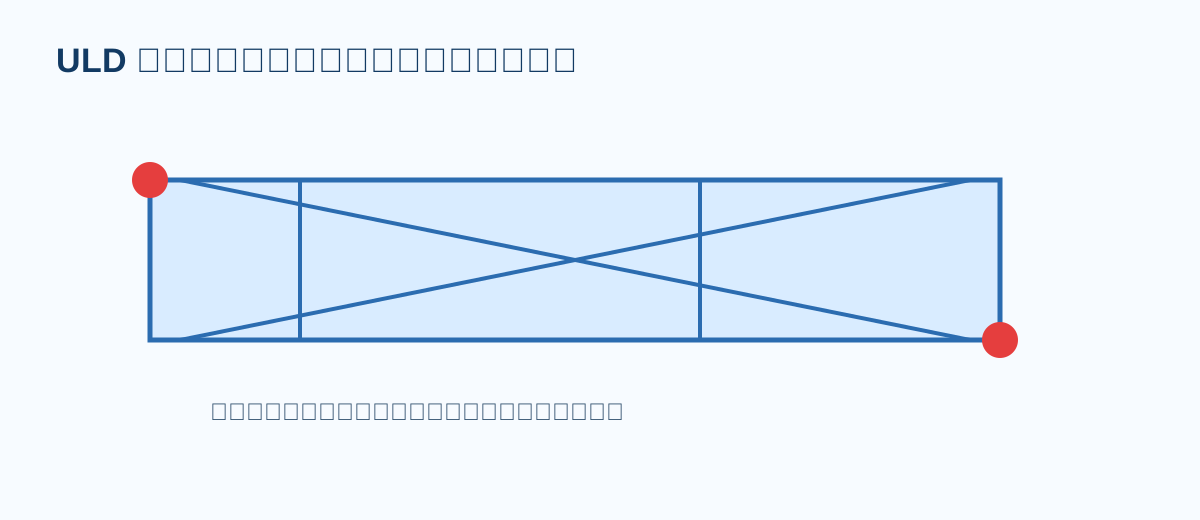
Schematic of an ULD Airworthiness Inspection
Why ULDs Require Airworthiness Inspections
ULDs leave the control of airlines and pass through many stages, including freight forwarders, warehouses, trucks, and ground handling agents. IATA points out that ULD-related operations result in significant repair and loss costs each year, and can also affect flight safety and cause delays.
The purpose of airworthiness inspections is to confirm that ULDs remain capable of securing cargo during flight.
Items Subject to Inspection
Why It Is Important
Floor Panel
Cargo Weight Capacity
Side Rails
Connects to the aircraft latching system
Netting
Secures cargo to prevent movement
Straps
Used to secure special cargo
Nameplates/Serial Numbers
Identify ULD type and airworthiness status
ODLN/Damage Limits
Determining whether damage exceeds limits
As long as the damage affects the securing capability or the structural safety of the aircraft, it cannot simply be deemed “still usable.”
What Risks Does a Failed Locking Mechanism Pose?
The purpose of the latches is to secure the ULD in place within the aircraft cargo hold. During flight, the aircraft experiences acceleration, deceleration, turbulence, climbs, descents, and turns; cargo must be effectively secured.
Latch Issues
May Affect
Failure to lock
The ULD cannot be secured
Damage to the latch mechanism
May alter the loading position
Multiple latches are inoperable
May result in bay unavailability
Latches do not match the ULD
Requires adjustment of the loading plan
Latch status not confirmed
The airline may refuse to load the pallet
Therefore, a lock failure is no trivial matter. When freight forwarders hear “lock issue,” they should not simply assume it’s due to slow airport operations—it may directly affect whether the entire pallet can be loaded onto the aircraft.
What Is Typically Checked During ULD Airworthiness Inspections
Area
Common Issues
Risks
Base Plate
Deformation, cracks, perforations, severe dents
Reduced load-bearing capacity
Side Rails
Bending, breakage, missing
Unable to lock
Netting
Holes, broken ropes, damaged fasteners
Insufficient restraint capability
Straps
Wear, tears, missing labels
Failure to secure
Nameplate
Missing, illegible
Unable to verify ULD identity
Corner pieces
Damaged, deformed
Structural risk
Actual determinations must be made in accordance with the relevant standards of airlines, maintenance stations, and IATA ULDR. Freight forwarders should not make their own judgment that an item “looks serviceable.”
The Most Common Mistakes Made in Palletizing Warehouses
Error
Consequences
Continuing to load cargo onto damaged pallets
Airline refusal to accept or unloading and rework
Netting does not match the height
Insufficient cargo securing
Cargo pressed against the side rails
Damaged ULD or unable to lock
Unauthorized drilling, welding, or reinforcement
Compromised airworthiness
Failure to record ULD numbers
Disorganized reconciliation and tracking
Forcing cargo beyond the ULD’s dimensions
Potential damage to aircraft and cargo
The biggest pitfall in ULD operations is “warehouse empiricism.” Aviation pallets are not wooden pallets; they cannot be repaired, compressed, or borrowed at will.
ULD Inspection Checklist
Stage
Action
Responsible Party
1. Receipt of Empty ULDs
Check serial number, appearance, and suitability
Warehouse/Ground Agent
2. Pre-palletizing Inspection
Base panels, side rails, mesh containers, labels
Palletizer
3. In-Process Control
Do not exceed the outline; do not press against the side rails
Warehouse
4. Post-assembly inspection
Netting, straps, center of gravity, labels
Supervisor/Airline
5. Airline acceptance
Airworthiness status and loading documents
Airline/GHA
6. Pre-loading Confirmation
Latches, Panel Positions, Weight and Balance
Loading Personnel
If the customer requests to build pallets or SBUs (Shipper-Built ULDs) on their own, training and standards must be given even greater attention. IATA also places special emphasis on the safety and quality of Shipper-Built ULDs.
How to Handle ULD Irregularities
Anomalies
Recommended Actions
Damaged Empty ULD
Replace the ULD; do not force its use
Out-of-contour discovered after PCB production
Disassemble the panel and remanufacture it
Screen does not meet specifications
Replace with a compatible screen
Buckle issues
Awaiting airline/GHA determination of available space
Airline refusal
Document the reason and make corrections as required
When shipping large air freight shipments, the biggest concern is having to unpack pallets and redo the packing. Unpacking a pallet not only increases handling fees but may also result in missing the flight.
Common Misconceptions
Misconception 1: ULDs are packaging materials for freight forwarders.
ULDs are aircraft components and are subject to strict airworthiness requirements.
Misconception 2: Minor damage does not affect usability.
Whether damage affects usability depends on established standards, not visual inspection alone.
Misconception 3: It’s okay if one latch is broken.
It depends on the location, number of damaged latches, aircraft type restrictions, and the loading plan.
Misconception 4: Just covering the cargo with a net is sufficient.
The netting must be compatible with the pallet type, cargo height, and restraint requirements.
Misconception 5: It’s easier for customers to build their own ULDs.
SBUs have stricter requirements for training, standards, and acceptance.
Checklist
[ ] ULD number, pallet type, and airline affiliation are clearly identified
[ ] No visible damage exceeding permissible limits on the base plate, side rails, or corner fittings
[ ] Netting, fasteners, and straps are in good condition
[ ] Cargo does not press against the side rails and does not exceed the outline
[ ] Heavy cargo has shims or a load distribution plan
[ ] Labels, markings, and special cargo codes are complete
[ ] Self-inspection completed prior to airline/GHA acceptance
[ ] Photographs and records of any anomalies are available
How do latch malfunctions affect customer transit times?
Customers usually only see the end result: “Why didn’t my shipment fly?” But on the ground, there may be many steps involved: Loading personnel discover that a latch on a specific pallet position won’t lock properly, and the airline must determine whether to reassign the pallet position, whether it affects the load balance, whether the pallet needs to be disassembled, or whether other ULDs need to be reconfigured.If the flight schedule is very tight, this series of decisions could result in cargo being left behind.
On-Site Procedures
Time Impact
Lock Mechanism Malfunction Detected
Pause for verification
Check other pallet positions
May need to change the loading sequence
Replace/remove board
Requires rework and re-inspection
Rebalance
Recalculation of airline load and balance
Insufficient time remaining
May result in cargo being offloaded or flight changes
Therefore, while a latch malfunction may appear to be an airport equipment issue, it can actually affect the delivery time and cost of the entire shipment.
How Can Freight Forwarders Minimize ULD Anomalies in Advance
Actions
Value
Use Authorized Airline Warehouses
Reduce the risk of non-compliant ULDs
Take photos before loading onto pallets
Document the initial condition of the ULD
Verify pallet configurations and netting
Avoid mismatches upon arrival
Report Oversized Cargo to the Airline in Advance
Avoid making last-minute decisions on-site
Allow extra time for large shipments
Allow for pallet disassembly and replacement
Standardize documentation of anomalies
To facilitate explanations to clients
Freight forwarders must be especially cautious with SBUs or customer-built pallets. Just because a customer has packed the cargo properly doesn’t mean the airline will accept it.
A simple way to explain ULD airworthiness to clients
You can explain it this way:
An air cargo unit load device (ULD) is not an ordinary pallet; it is secured in the aircraft cargo hold during flight. If any component—the pallet, netting, side rails, or locking mechanisms—compromises its securing capability, the airline may refuse to accept the shipment. We conduct these pre-shipment inspections to avoid having to disassemble the ULD and redo the work once the cargo arrives at the airport.
This explanation helps clients understand why what “seems like just a pallet issue” can turn into “a problem that prevents the cargo from flying.”
Why ULD Management Is Important for Dedicated ULD Freight Forwarders
Freight forwarders operating dedicated ULDs sell more than just cargo space—they also sell delivery certainty. Poor ULD management directly impacts the customer experience:
Management Weaknesses
Consequences
Poor empty ULD scheduling
Delays in Loading
Mismatched ULD types
Cargo cannot be loaded as scheduled
Inadequate airworthiness inspections
Airline refusal to accept
Chaos in tracking numbers
Difficulties with reconciliation and claims processing
Insufficient netting
High-volume cargo cannot be secured in compliance with regulations
Professional freight forwarders should manage ULDs as assets and safety priorities, rather than as temporary tools.
Who Bears the Cost of ULD Irregularities
This is a common point of contention in practice. ULD anomalies may stem from the condition of the airline’s equipment, or from palletizing at the warehouse, customer packaging, or cargo damage. Liability must be determined based on records.
Scenarios
Possible Liability
Damage present upon receipt of an empty ULD
Must be documented with the provider
Damage during palletizing
The warehouse or operations team may bear significant responsibility
Damage caused by sharp edges in the packaging
Responsibility lies with the shipper or the packer
Changes in the airline’s acceptance standards
Must be handled in accordance with the carrier’s rules
Damage during transit
Review handover records and determine the cause of the incident
Therefore, taking photos before and after loading onto the pallet is not a superfluous step. Especially for high-value ULDs, special cargo, heavy cargo, and customer-built pallets, photos and handover records can protect all parties in the event of a dispute.
Internal ULD SOPs That Freight Forwarders Should Establish
SOP Procedures
Content
Receiving the ULD
Check the number, pallet type, and appearance
Palletizing
Control dimensions, weight, and center of gravity
Acceptance
Board layout, labels, strapping, and photos
Handover
Record time, personnel, and status
Anomalies
Stop use, take photos, report
Training
Inform the warehouse that ULDs are not pallets
The more standardized ULD management is, the smoother airline acceptance will be, and the more stable delivery times for customers will be. For freight forwarders with dedicated space, this is not a minor back-office matter, but a matter of product delivery capability.
The Relationship Between ULD Airworthiness and Customer Experience
Customers typically don’t care about ULD details, but they do care whether their cargo flies on time. Freight forwarders must translate internal technical processes into service value that customers can understand. For example, “We conduct ULD airworthiness pre-checks” actually means to customers: fewer rework due to pallet disassembly, fewer airline rejections, fewer flight delays, and lower risk of cargo damage.
Internal Operations
Customer Value
Pallet Acceptance Inspection
Avoids the use of non-compliant pallets
Pallet Assembly and Photography
Documenting anomalies
Mesh Matching
Reduce Rejections
Verify the status of the latches
Reduces the risk of on-site cargo abandonment
Anomaly Reporting
Adjust Plans in Advance
If your clients are project cargo or full-container load (FCL) customers, you can include these procedures in your service guidelines. Clients may not be familiar with ULDs, but they will understand that you are implementing risk control measures.
How to Document Locking Issues in Anomaly Reports
When a latch or ULD anomaly occurs, the report must include at least the following: flight number, ULD number, time the anomaly was discovered, location of the anomaly, on-site photos, airline/GHA comments, actions taken, whether loading was affected, and the status of pending follow-up costs and liability. Do not simply say “the latch is broken” in a group chat.
Standardized exception reports protect the operations team and ensure clients understand that exceptions are not merely casual explanations. A significant part of the professionalism in air cargo lies in the clarity of exception documentation.
A Reminder for Management
While ULD management may seem like a detail of warehouse and operations, it actually impacts company profits. A single instance of unloading and reloading a pallet can lead to flight delays, customer complaints, overtime costs, and wasted cargo space; a dispute over ULD damage can affect airline relationships and subsequent billing.
If a freight forwarder wants to handle block space, chartered flights, and project cargo, it cannot focus solely on sales capabilities; it must also invest in warehouse training, loading standards, anomaly documentation, and ULD management. The true mark of excellence in air freight often lies hidden in these seemingly mundane, foundational tasks.
How to Define ULD-Related Responsibilities with Clients
Whether the ULD is loaded by the client, at a client-designated warehouse, or due to client packaging, liability must be clearly defined before the shipment begins.Do not wait until damage occurs to discuss who will compensate for it. In particular, sharp metal parts, heavy equipment, wooden crates with exposed nails, and cargo with irregular bases must be inspected and documented before palletizing. Clarifying liability is not meant to scare clients, but to ensure they understand that air freight pallets cannot be treated as ordinary floorboards.
One Final Practical Reminder
If a shipment is on a tight deadline, you must not skip the ULD inspection. The more urgent the shipment, the less it can withstand the delays caused by unloading, reloading, or carrier rejection. A ten-minute inspection in advance could save ten hours of rework later. ULD management isn’t a slow process—it’s the foundation for ensuring on-time delivery.
This is also why established airlines and GHA are so sensitive to ULD condition.
When the details are solid, the flight schedule is secure.
This is also the fundamental skill that dedicated ULD teams must continuously hone.
The more solid your fundamentals, the less you’ll panic during peak seasons.
This isn’t just a slogan—it’s the meticulous engineering behind flight on-time performance.
It’s also profit.
It’s very real.
Professional Summary
The core of an ULD airworthiness inspection is confirming that the pallet can securely contain cargo during flight. Latches, side rails, and pallet netting may seem like minor details, but they are actually links in the chain of aviation safety.
Once freight forwarders and clients understand this, they will no longer view “pallet swaps, disassembly, or latch malfunctions” as causes of airport delays. Air freight efficiency is important, but it must not come at the expense of airworthiness and cargo containment.
This article is intended as industry knowledge and a practical reference; it does not constitute advice on ULD maintenance, airworthiness determinations, or aviation safety. For specific ULD inspections, damage limits, and latch usability, please refer to the requirements of airlines, the IATA ULDR, ground handling agents, and maintenance providers.