Disclaimer — This article is provided as general logistics industry knowledge and practical reference only. It does not constitute aviation safety, dangerous goods carriage, legal, tax or other professional advice. Actual transport, declaration, packaging, loading and customs requirements are subject to the carrier, competent authorities, official regulations and professional advice.
Loading a freighter isn’t as simple as parking the plane on the apron and having a forklift push the cargo inside. The B757F, B767F, and B747F are different aircraft types, so the cargo door height, main deck height, cargo hold space, ground equipment, and loading pace all vary.For freight forwarders and project clients, having a basic understanding of ground operations isn’t about micromanaging the airport—it’s about identifying which risks must be mitigated in advance when preparing quotes and ensuring on-time delivery.
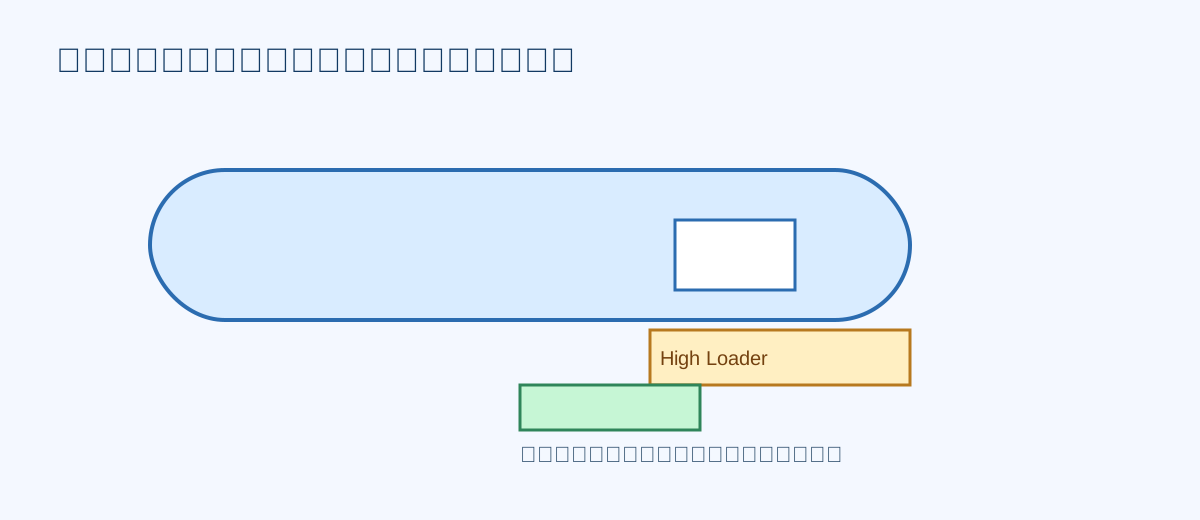
Schematic of All-Cargo Aircraft Ground Operations
Ground Operations Determine Whether a Flight Can Depart as Scheduled
In charter projects, the aircraft is just one link in the chain. What truly determines whether a flight can depart on time is the coordination between the aircraft, ground equipment, personnel, cargo, documentation, security screening, and weight and balance.
Key Steps
Impact
Parking Bay
Suitability for cargo aircraft loading and unloading
High-Loading Aircraft
Ability to dock with the main deck cargo door
Forklifts/Tug Trucks
Can it move heavy or long cargo?
Conveyor belt/ball pads
Can ULDs be pushed in?
Security screening
Does it support oversized, hazardous, or special cargo?
Personnel
Are they familiar with this aircraft type and the cargo?
Documentation
Are the AWB, DGD, and special cargo instructions complete?
The same shipment may proceed smoothly at an airport familiar with cargo aircraft operations, but could result in a major on-site incident at an airport lacking the necessary equipment and experience.
Differences in Ground Operations for the B757F, B767F, and B747F
Aircraft Type
Operational Characteristics
Suitable Scenarios
Points to Note
B757F
Narrow-body freighter with a relatively small main deck door
Regional express shipments, e-commerce, and standard cargo
Limited capacity for oversized cargo
B767F
Medium-sized wide-body freighter
Medium-range charter flights, express shipments, general cargo
Main deck capacity exceeds that of the 757, but remains limited
B747F
Large wide-body freighter with the advantage of a nose door
Extra-long, oversized, heavy cargo, and long-haul charter flights
High costs and support requirements
According to official Boeing data, the 767-300F is a medium-sized wide-body freighter with a structural payload capacity of approximately 56.6 metric tons and a net payload capacity of approximately 52.4 metric tons; the 777F is larger, while the 747F still holds unique value for oversized cargo projects.
Having a high-loader isn’t enough
A high loader is one of the core pieces of equipment for loading and unloading main-deck cargo aircraft. However, high loaders also have limitations regarding model, load capacity, platform dimensions, lifting height, and operational constraints.
Criteria
Why It Matters
Lifting Height
Ability to dock with the cargo door
Platform Dimensions
Ability to Handle Oversized/Over-width Cargo
Load Capacity
Can it handle heavy cargo?
Rollers/Conveyor Belt
Compatibility with ULD movement
Airport Availability
Does it require advance booking?
Backup Equipment
Is there a replacement available in case of equipment failure?
If a customer suddenly changes their cargo from standard containerized freight to overweight machinery, it may result in the originally scheduled high-loader being insufficient. Ground equipment is not available on demand.
Ground Operations Checklist
Stage
Action
Risk
1. Aircraft Arrival
Parking position, chocks, ground power connection
Incompatible parking position
2. Equipment Docking
High-lift equipment, conveyors, forklifts
Height/load capacity mismatch
3. Cargo Security Screening
X-ray, manual inspection, special cargo inspection
Oversized items cannot pass through the scanner
4. Palletizing/Pallet Preparation
ULD airworthiness, netting, and labeling
Rework
5. Loading
Pushing pallets, locking, securing
Carmen, Locking Mechanism Issues
6. Trim Verification
Loading position and weight
Temporary Adjustments
7. Closing the hatch
Check Safety Zones
Delays
Freight forwarders should focus on pre-loading preparations rather than waiting until the loading site to begin coordination.
What to Ask in Advance Regarding Ground Handling of Oversized Cargo
Does the origin airport have a high-loader with sufficient lifting capacity?
Does the destination airport have equivalent equipment?
Can the cargo pass through security screening equipment? If not, are there alternative screening methods available?
Are cranes, specialized forklifts, or low-bed trailers required?
Can the cargo be moved between the airport warehouse and the apron?
Is the packaging suitable for conveyor belts and forklifts?
Are nighttime or special-time-of-day operations required?
Why Is Ground Handling for the B747 More Complex?
The B747F is highly capable, but its ground handling requirements are correspondingly high. Nose-door loading, the high main deck, large and tall cargo, the handling of long items, on-site safety zones, and unloading equipment at the destination port all require advance planning.
Key Considerations for the B747F
Reason
Nose Door Operation Area
Sufficient space is required in front
Main Deck Height
Must be compatible with high-load capacity
Propulsion for extra-long cargo
Requires coordinated use of roller conveyors and towing
Heavy-load shims
Floor load control
Equipment at the destination port
Failure to unload is more problematic than failure to load
In B747 charter projects, confirming destination port equipment is just as important as confirming origin port equipment.
Common Misconceptions
Misconception 1: Having an all-cargo aircraft means you can load oversized cargo.
Ground equipment and cargo door capacity are equally critical.
Misconception 2: All airports have high-loaders.
Just because a high-loader is available doesn’t mean its model, load capacity, and operating hours are suitable.
Misconception 3: Loading issues can be resolved on the spot.
Specialized equipment and personnel usually need to be booked in advance.
Misconception 4: Unloading at the destination port doesn’t require advance planning.
Failure to unload at the destination port poses even greater risks.
Misconception 5: The B757F, B767F, and B747F differ only in size.
Their cargo doors, platforms, main decks, and operational procedures differ significantly.
Ground Operations Checklist
[ ] Do the origin and destination airports support the corresponding aircraft type?
[ ] Have the high-load capacity, height, and platform dimensions been confirmed?
[ ] Are special forklifts, cranes, or low-bed trailers required?
[ ] Has the security screening plan for oversized cargo been confirmed?
[ ] Is the ground route from the apron to the warehouse feasible?
[ ] Is the cargo packaging suitable for conveyor belts, forklifts, and crane handling?
[ ] Resources for nighttime, weekend, and holiday operations have been confirmed
[ ] Backup equipment and contingency plans are in place
A Typical Scenario of Ground Handling Failure
A customer had a shipment of construction machinery parts. Loading at the origin airport went smoothly, and the cargo was loaded onto a B767F bound for its destination. The problem arose at the destination airport: although the local airport could accommodate a B767F, there were no high-capacity loaders available at night, and truck reservations had not been coordinated.After the aircraft landed, the cargo could not be unloaded as originally planned and had to wait until the equipment was available the following day, resulting in costs associated with aircraft turnaround, warehousing, and the customer’s factory downtime.
This case illustrates that ground handling is not solely the responsibility of the origin port; it must be confirmed at both the origin and destination.
Overlooked Confirmation Items
Consequences
Tonnage capacity of high-loaders at the destination port
Delay in unloading
Nighttime operational resources
Waiting time after flight arrival
Truck reservations
Inability to transfer cargo after unloading
Customs operating hours
Cargo Cannot Be Released
Warehouse Receiving Capacity
On-site Storage Risks
Project cargo logistics do not end once the shipment arrives; rather, they form a closed-loop process from the factory gate to the customer’s site.
How Should Freight Forwarders Communicate with the Airport/GHA in Advance
Communication Content
Purpose
Aircraft Type and Flight Schedule
Confirmation of parking bays and personnel
Maximum Weight per Piece
Confirmation of high-load aircraft and forklifts
Maximum Dimensions per Item
Confirm cargo doors, warehouse doors, and routes
Hazardous materials, live animals, or temperature-controlled cargo
Confirm special handling capabilities
Whether nighttime operations are required
Confirm overtime and permits
Determining whether lifting operations are required
Confirm crane availability and safety zone
Pickup arrangements at the destination port
Avoid delays after unloading
The more specific the communication, the better GHA can assess feasibility. Simply stating “there is a large shipment” is not helpful.
Sales Terminology for Different Aircraft Types
Customers may not understand the differences between the B757F, B767F, and B747F. You can explain it this way:
Aircraft Type
What to Tell the Customer
B757F
Suitable for regional express shipments and standard cargo; limited capacity for oversized cargo
B767F
A medium-sized wide-body freighter, suitable for medium-range flights and cargo volumes of a certain scale
B747F
A large all-cargo aircraft with strong nose-door and oversized cargo handling capabilities, but with high costs and support requirements
This helps customers understand that aircraft selection is not based on the principle of “bigger is better,” but rather on matching the cargo and project constraints.
Safety Boundaries in Ground Operations
Freight forwarders cannot direct airport operations, but must respect safety boundaries:
The apron safety zone must not be entered without authorization;
Docking with high-load aircraft requires specialized personnel;
Cargo movement must follow GHA instructions;
Operations may be suspended due to rain, snow, or strong winds;
Dangerous goods and live animals have special acceptance and handling procedures;
On-site repackaging must be authorized.
The more parties involved in a charter flight project, the more critical it is to have a clear chain of command. Client personnel, factory personnel, and freight forwarders should not each issue their own instructions on the tarmac.
Why Airport Selection Can Affect Charter Plans
There may be multiple airports serving the same destination city. The choice of airport depends not only on proximity to the client but also on the cargo aircraft’s operational capabilities.
Airport Conditions
Impact
Whether the airport routinely handles all-cargo flights
Determines Operational Proficiency
Availability of aircraft with high-deck loading
Determines whether oversized cargo can be unloaded
Customs working hours
Determines the speed of clearance
Availability of cold storage/hazmat storage
Determines whether special cargo can be handled
Truck Availability
Determines subsequent transshipment
Airport restrictions
Noise, curfews, runways, and parking bays
Sometimes the airport closest to the customer isn’t the best option. Flying a bit farther and then transferring the cargo by truck may actually be more reliable than temporarily mobilizing equipment at a small airport.
How Freight Forwarders Conduct Post-Operation Reviews
After each charter flight, it is recommended to record: actual arrival time and loading/unloading times; whether equipment was in place as planned; whether there were any delays, rework, or modifications; whether cargo dimensions and weights matched the advance notification; whether there were any bottlenecks during security screening and customs clearance; whether cargo pickup at the destination port went smoothly; and what to pay attention to in advance for similar projects in the future.
These records will form the freight forwarder’s own project database. The more charter flights you handle, the less you can rely solely on human memory.
How Ground Operations Affect Pricing
When clients see a charter quote, they often assume it consists mainly of aircraft costs. In reality, ground operations can significantly alter the total price. Oversized cargo requires high-load loading, forklifts, cranes, low-bed trailers, apron safety coordination, nighttime overtime, and special security checks—none of which are free resources.
Ground Resources
Cost Impact
High-Loading Equipment
Equipment usage fees and booking charges
Heavy-duty forklifts
Airport or external equipment dispatch
Cranes
Special Operations and Safety Zones
Night Operations
Overtime and Airport Surcharges
Cold Storage/Hazmat Warehouse
Special Cargo Storage Fees
Ramp Waiting
Flight Delay Costs
If freight forwarders do not itemize ground handling costs in their quotes, clients will simply perceive airfreight as expensive; by itemizing these costs, clients can more easily understand the complexity of the operation.
Contingency Options in Case of Ground Handling Failure
Issues
Possible Contingency
Major Loading Equipment Failure
Deploy backup equipment or delay loading
Insufficient forklift capacity
Deploy a heavier-duty forklift or a crane
Failed safety inspection
Submit additional documentation, open the container, or modify the process
No equipment available at the destination port
Change to a different airport or arrange for external equipment
Weather-related issues
Suspend apron operations; transfer cargo to the warehouse and wait
Contingency plans must be prepared in advance; do not wait until the aircraft lands to secure resources.
Ground operations also require customer cooperation
The client’s responsibility does not end once the cargo is delivered to the airport. For oversized, heavy, temperature-controlled, and dangerous goods shipments, the client must cooperate by providing packaging diagrams, lifting instructions, a pickup contact person, destination port equipment arrangements, and customs clearance documents.
If the client’s on-site personnel need to supervise operations at the airport, their access permissions and safety requirements must be confirmed in advance. The apron is not a factory warehouse; unauthorized entry, photography, or issuing instructions are not permitted. The more complex the project, the more important it is to ensure the client understands that there are strict management boundaries at the airport.
The value of a freight forwarder lies in bridging the client’s site, the airport site, and airline regulations. A project runs smoothly not because one person is shouting the loudest on-site, but because every participant knows in advance exactly what they are supposed to do.
One final practical tip
The more complex the ground operations, the more essential it is to hold preparatory meetings. Even a 20-minute session to clarify equipment, personnel, routes, and responsibilities is more effective than last-minute on-site disputes. In charter projects, the cost of communication is always lower than the cost of on-site rework.
Communicating in advance saves money in the long run.
It also helps you avoid pitfalls in advance.
It’s a cliché, but it’s practical.
Professional Summary
Ground operations for all-cargo flights are a collaborative system. No matter how capable the aircraft is, if the load plan doesn’t match its capacity, forklifts aren’t heavy-duty enough, security screening plans are missing, or destination airport equipment is lacking, the flight may still be delayed or canceled.
If freight forwarders and project clients have a basic understanding of ground operations, they can identify risks before quoting—rather than leaving all issues to be resolved on-site at the airport.
This article is intended as an industry knowledge and practical reference and does not constitute airport ground handling or aviation safety instructions. For specific equipment, personnel, parking bay, and loading requirements, please refer to the operating manuals of the airline, airport, GHA, and aircraft type.