Disclaimer — This article is provided as general logistics industry knowledge and practical reference only. It does not constitute aviation safety, dangerous goods carriage, legal, tax or other professional advice. Actual transport, declaration, packaging, loading and customs requirements are subject to the carrier, competent authorities, official regulations and professional advice.
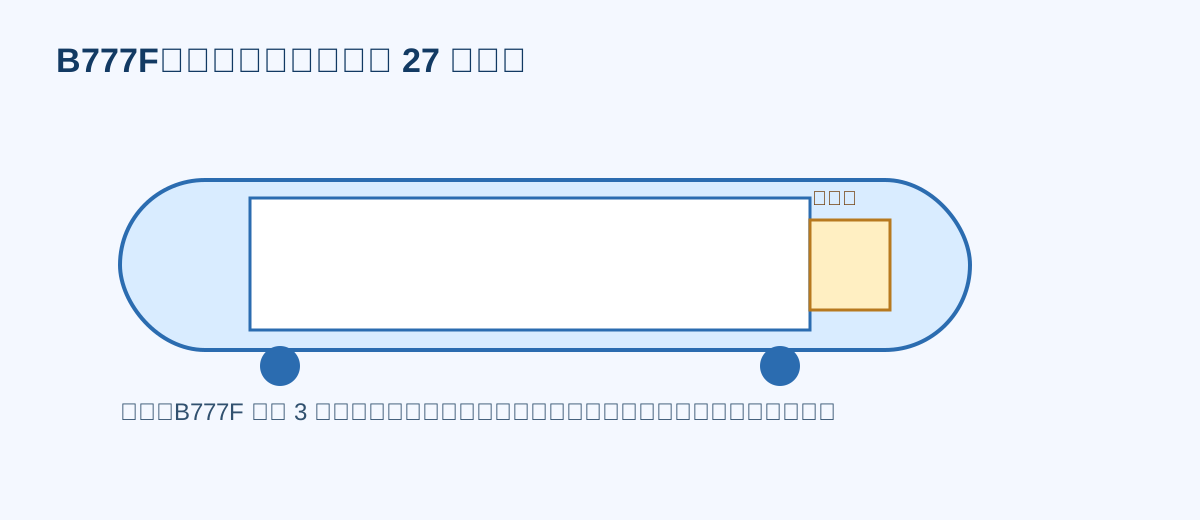
The B777F is one of the mainstay all-cargo aircraft in international air freight: it has a long range, high payload capacity, and high operational efficiency. According to official Boeing data, the 777F can accommodate 27 main-deck pallets, with a structural payload capacity of approximately 107 metric tons and a net payload capacity of approximately 102 metric tons.However, it does not have a nose door like the B747. For extra-long and oversized cargo, the key consideration for the 777F is not “how much it can carry,” but whether the cargo can fit through the side cargo doors, be maneuvered inside the cargo hold, and fit within the main deck’s external dimensions.
B777F Loading Diagram
What Cargo Is the 777F Suited For?
The B777F’s strengths lie in its long range, high payload capacity, twin-engine efficiency, and established route network. It is particularly well-suited for high-value general cargo, e-commerce charter flights, machinery and equipment, automotive parts, pharmaceuticals, electronics, project cargo, and certain oversized cargo.
Cargo Types
Suitability
Description
Standard Main Deck Cargo Area
High
777F: High Main Deck Capacity
High-density, heavy cargo
High
Subject to space availability and floor load capacity
E-commerce Charter Flights
High
Large volumes of containerized cargo with reliable transit times
Oversized Cargo
Medium
Depends on the side-door access angle
Extra-tall cargo
Medium
Depends on the main deck profile and door height
Long items requiring direct loading through the bow door
Low
May be better suited for the B747F
The 777F is not a replacement for the 747F, nor is it a scaled-up version of the 767F. The decision-making logic is clear: if cargo can be loaded through the side cargo door and positioned on the main deck, the 777F is a strong choice; if cargo must be loaded straight in from the front, the 747F has the advantage.
The side cargo door is the key factor in determining whether a B777F can accommodate a shipment
When loading oversized cargo onto a side-door freighter, the biggest concern is that “while the dimensions may fit on paper, the cargo cannot actually be maneuvered into place.” After entering through the side cargo door, cargo typically requires a certain degree of repositioning before it can be placed on the main deck. The loading path is particularly critical for long items, rigid items, and equipment with wide bases.
Criteria
Why It Matters
Door Width and Height
Determine whether cargo can be loaded
Entry Angle
Determines whether long items can be maneuvered inside
Cargo Rigidity
Items that cannot be bent or disassembled will increase the difficulty
Base Height
Affects overall height and center of gravity
Height of ground-level equipment
A high-loading platform must be compatible with the cargo door
In-cabin roller bed
Determines propulsion and positioning
If the cargo dimensions provided by the customer are close to the threshold, it is recommended not to rely solely on verbal assessments. The airline or GHA should be asked to perform a loading assessment, and a load survey or simulation should be conducted if necessary.
B777F Main Deck Palletization Logic
The B777F main deck typically uses air cargo pallets and netting for loading.Official Boeing documentation states that the 777F can carry 27 main deck pallets and accommodate pallets up to 3 meters in height. It is important to note that “capable of accommodating 3-meter-high pallets” does not mean that any 3-meter-high cargo can be loaded into every position.
Dimensions
Practical Tips
Pallet Positions
Available load profiles and restrictions may vary by location
Outline
The higher the height, the more the available width is affected by the fuselage curvature
Netting
Must match the height of the pallet and the cargo
Latches
The pallet must be securely locked in place
Weight
There are load limits per pallet and per zone
According to IATA guidelines, ULDs are aircraft components; airworthy ULDs must be capable of securing the cargo and protecting the aircraft structure. For the 777F, the cargo pallet is not a standard pallet but rather part of the flight safety chain.
B777F Loading Procedure
Stage
Action
Key Points
1. Collection of Cargo Information
Dimensions, weight, photos, center of gravity
The more complete the information, the better
2. Side Door Compatibility Assessment
Door height, door width, entry angle
Focus on oversized cargo
3. Deck Type Selection
Main deck types such as PMC/PAG
Based on the cargo base and outline
4. Damping/Securing Solutions
Heavy cargo requires pressure distribution
Prevent point loads from exceeding limits
5. Confirmation of ground equipment
High-lift equipment, forklifts, and roller conveyors
Confirmation required at both port of loading and port of destination
6. Palletizing and Shipping
Pallet netting, labels, and airworthiness inspection
Non-compliant ULDs cannot be loaded onto the aircraft
7. Loading and Trimming
Weight and balance, cargo hold allocation
Ultimately controlled by the airline
If you’re a cross-border seller of oversized items, a common mistake is to view the B777F through the lens of standard express shipping dimensions. The aircraft’s main deck is not a flat warehouse floor; cargo must meet requirements for cargo doors, external dimensions, flooring, securing, and weight and balance.
How to Choose Between the B777F and B747F
Scenarios
More Suitable for the B777F
Better Suited for the B747F
Standard Pallets
Yes
Also acceptable
Long-range, high-density general cargo
Yes
Depends on cost
Extra-long straight items
Assess based on side-door access
More advantageous
Must be loaded through the front door
No
Yes
Cost-effective
Generally better
Depends on the market and route
Very large project cargo
requires evaluation
Often given priority
The B777F’s strengths lie in efficiency and network coverage, while the B747F’s strengths are its nose door and ability to handle oversized cargo. Decisions regarding project cargo should not be based solely on an aircraft model’s reputation.
What to Ask the Customer Before Quoting
[ ] Whether the length, width, and height of each piece include packaging and the base
[ ] Weight per piece and total weight
[ ] Whether the cargo can be tilted, rotated, or disassembled
[ ] Center of gravity, lifting points, and forklift holes
[ ] Can the item be loaded onto a pallet? Is a dunnage board required?
[ ] Is it a hazardous material, live, or temperature-controlled?
[ ] Do the ports of origin and destination have high-lift equipment capabilities?
[ ] Are CAD drawings or three-view diagrams available?
For the B777F, the “angle” of oversized cargo is particularly critical. Many shipments cannot be loaded not because the door height is insufficient, but because they cannot be maneuvered after entering through the side door.
Common Misconceptions
Misconception 1: The 777F has a high payload capacity, so it can handle any heavy cargo.
It also depends on the weight of individual pieces, floor load capacity, cargo bay distribution, and dunnage.
Misconception 2: If a 3-meter-high pallet fits, then all 3-meter cargo will fit.
You must also consider the cargo’s dimensions, positioning, netting, and operational space.
Misconception 3: The 777F can replace the 747 nose door.
For extra-long cargo requiring straight-line access, the 777F’s side door may be too narrow.
Misconception 4: Confirming the aircraft type is the same as confirming the load.
Aircraft type confirmation is only the first step; you must also review the loading diagram and on-site conditions.
Practical Implementation of OneCargoKit
When making a preliminary assessment of the B777F option, you can start by using:
ULD Calculator: To pre-screen pallet types, outlines, and cargo dimensions.
While these tools cannot replace confirmation from the airline, they allow you to filter out obviously unreasonable proposals during the quotation phase.
Three Typical Cargo Categories for B777F Inquiries
Cargo Types
Key Considerations for B777F
Recommendations
E-commerce charter container cargo
Space Utilization, Billable Weight, Flight Frequency
Suitable for the B777F, but precautions against low-density cargo are necessary
Mechanical Equipment
Individual piece dimensions, side door access angle, floor load capacity
Provide drawings and center of gravity
High-value electronics/pharmaceuticals
Transit time, temperature control, security, cargo hold stability
Focus on ground handling
The B777F is commonly used for e-commerce charter flights because it offers a well-balanced combination of range, payload, and cost-effectiveness. However, common challenges with e-commerce cargo include significant variations in outer box dimensions, high bulk-to-weight ratios, and large fluctuations in cargo volume during peak seasons. If sales teams quote based solely on “estimated tonnage capacity,” the actual shipment may exceed capacity due to volume constraints.
For machinery and equipment, the key consideration with the B777F is not the payload capacity, but the access route through the side door. While the weight of many pieces of equipment is not an issue, their length, base dimensions, and turning angles can complicate the loading plan.
The Relationship Between the B777F and Block Space
B777F charter or block space projects often revolve around the main deck cargo holds. Freight forwarders must understand that the value of a cargo bay slot depends not only on weight but also on the shape of the cargo.
Cargo Mix
Results
All Light and Bulky Cargo
High volume but low weight, resulting in poor profitability
All heavy cargo
Weight requirements met, but pallet space may not be fully utilized; depends on the load
Mixed Heavy and Light Cargo
More likely to achieve reasonable returns
Mixed Special Cargo
Requires consideration of segregation and loading restrictions
If you secure space on the B777F main deck, don’t just think about “selling kilograms.” What you really need to manage are deck spaces, dimensions, weight, and customer priority.
The Most Common Issues on the B777F Floor
Issue
Cause
Prevention
Cargo Exceeds Dimensions
Changes to the outer packaging or inaccurate measurements
Re-measure and re-weigh
Difficulty Entering Through Side Doors
Insufficient angle for long items
Advance simulation or probe testing
Heavy cargo requires repositioning
Balancing or floor restrictions
Provide center of gravity and base dimensions in advance
Non-compliant ULD
Pallet or side rail issues
Airworthiness inspection
Slow unloading at destination port
Equipment or customs clearance not prepared
Pre-shipment Confirmation
For customers, the B777F is a versatile aircraft; for operations, it remains subject to a strict set of rules. Versatility does not mean careless loading.
B777F Customer Communication Script
You can explain it this way:
The B777F is well-suited for long-haul and heavy-load shipments, but it is loaded through the side door.We need to confirm the cargo’s maximum external dimensions, individual piece weight, center of gravity, whether it can be tilted, and its base structure. For oversized or near-limit cargo, an entry path assessment must be conducted first. Final acceptance for carriage is subject to the airline’s loading confirmation and on-site clearance.
This statement is both professional and helps prevent clients from misinterpreting the aircraft type confirmation as an absolute guarantee.
How to Turn the Advantages of the B777F into Freight Forwarding Products
For freight forwarders, the B777F is more than just an aircraft model name; it can be packaged into several product categories.
Product Directions
Suitable for Customers
Key Selling Points
E-commerce Charter Flights
Platform sellers, dedicated logistics companies
Consistent cargo capacity, long range, and main deck space
Industrial Project Cargo
Equipment Exporters
High payload capacity, long range, and easier to secure than a 747
However, product development must not overlook these limitations. For example, e-commerce cargo requires control over light-weight, high-volume shipments; project cargo depends on side-door access; and temperature-controlled cargo relies on cargo hold space and ground cold chain infrastructure. The B777F is highly capable, but we cannot cram all customers into a single product offering.
Key Risk Clauses in the B777F Solution
When providing quotes to clients, it is recommended to clearly state: flights and aircraft types are subject to the carrier’s final confirmation; oversized cargo is subject to the airline’s loading assessment; prices and solutions may be adjusted if the actual measured dimensions and weight of the cargo differ from the forecast;special cargo, dangerous goods, and temperature-controlled cargo require separate carrier approval; final loading is subject to weight and balance, weather, airport operations, and security screening; unloading and customs clearance at the destination port are the responsibility of the party confirmed by both parties.
These terms are not intended to diminish the quality of service, but rather to help clients understand that the B777F is an air freight project, not a standard courier order.
How to Develop the B777F into a Stable Product
If freight forwarders wish to operate B777F routes long-term, they cannot rely solely on ad-hoc price quotes. It is best to establish their own cargo type database: which clients ship light-bulk e-commerce cargo, which ship high-density general cargo, which ship equipment project cargo, and which ship temperature-controlled or special cargo. The mix of these cargo types determines whether the route can remain profitable over the long term.
Management Items
Purpose
Customer Cargo Type Classification
Determining Whether to Sell by Kilogram, Pallet Space, or Full Charter
Container Specifications Database
Estimate volume utilization in advance
List of Heavy Cargo Customers
Used to pair with light-bulk cargo
List of Special Cargo Capabilities
Confirm whether airlines and airports can accept the shipment
Destination Port Agent Warehouse
To avoid shipments arriving with no one to handle them
The operational value of the B777F lies in its stability. If a flight constantly involves last-minute cargo consolidation, last-minute panel changes, or last-minute handling of oversized cargo, the team will become extremely exhausted. Only by documenting common cargo types and client rules can we develop a solid product.
Reminders for Cross-Border E-Commerce and Project Clients
Cross-border e-commerce clients should pay attention to box dimensions and volumetric weight. While the B777F’s main deck offers ample space, light and bulky cargo will fill the volume first, leading to higher costs.Project clients, on the other hand, should focus on side-door access and single-piece restrictions. When you ask, “Can we use the 777F?”, what the freight forwarder really needs to assess is: Can your cargo be loaded through the side door? Can it be positioned within the cargo hold? Does it require dunnage or special securing?
If clients can provide accurate dimensions, container specifications, and cargo attributes in advance, the B777F can serve as a highly reliable cross-border trunk line solution; however, if clients only provide vague estimates, any quote will carry inherent risks.
How to Operate the B777F as a Reliable Trunk Line Service
The B777F is best operated as a reliable trunk line capacity rather than as a temporary stopgap solution. The more stable the client base, the clearer the container specifications, and the more mature the destination port, the greater the value this aircraft type can deliver.Freight forwarders can establish a database of customer cargo types: which are light and bulky e-commerce shipments, which are high-density general cargo, which are equipment and project cargo, and which are temperature-controlled or special cargo. The mix of these cargo types determines whether this route can remain profitable over the long term.
If every flight involves ad-hoc cargo consolidation, last-minute vessel changes, and handling of oversize cargo, the team will become extremely exhausted. Only by documenting common cargo types, regular clients, and destination port regulations can the B777F be transformed from “one-off bookings” into a “replicable product.”
Professional Summary
The B777F is an exceptionally capable all-cargo aircraft, but its loading logic differs from that of the B747F. The key factors for the 777F are the side cargo doors, main deck profile, pallet constraints, and load balance; whereas the 747F’s key advantage lies in its nose-loading capability.
For freight forwarders and project clients, the most important thing is not to let the notion that “the 777F is very large” replace technical judgment. Whether a flight is truly feasible depends on the combined factors of doors, cargo decks, cargo, equipment, weight and balance, and the destination airport.
This article is intended as an industry knowledge and practical reference and does not constitute advice regarding aviation safety, loading engineering, or carrier liability. For specific B777F loading capacities and restrictions, please refer to the airline’s service guidelines, ground handling agents, and the aircraft type loading manual.