Disclaimer — This article is provided as general logistics industry knowledge and practical reference only. It does not constitute aviation safety, dangerous goods carriage, legal, tax or other professional advice. Actual transport, declaration, packaging, loading and customs requirements are subject to the carrier, competent authorities, official regulations and professional advice.
The phrase customers find hardest to understand is: “There seems to be room left—why can’t we load more?” This is because an aircraft cargo hold is neither a warehouse nor a shipping container.Air cargo loading must comply with requirements for external dimensions, weight limits, center of gravity, securing mechanisms, access aisles, temperature control, dangerous goods segregation, and operational clearance. The limit for maximum cargo hold filling is not determined by the gaps visible to the naked eye, but by safety regulations.
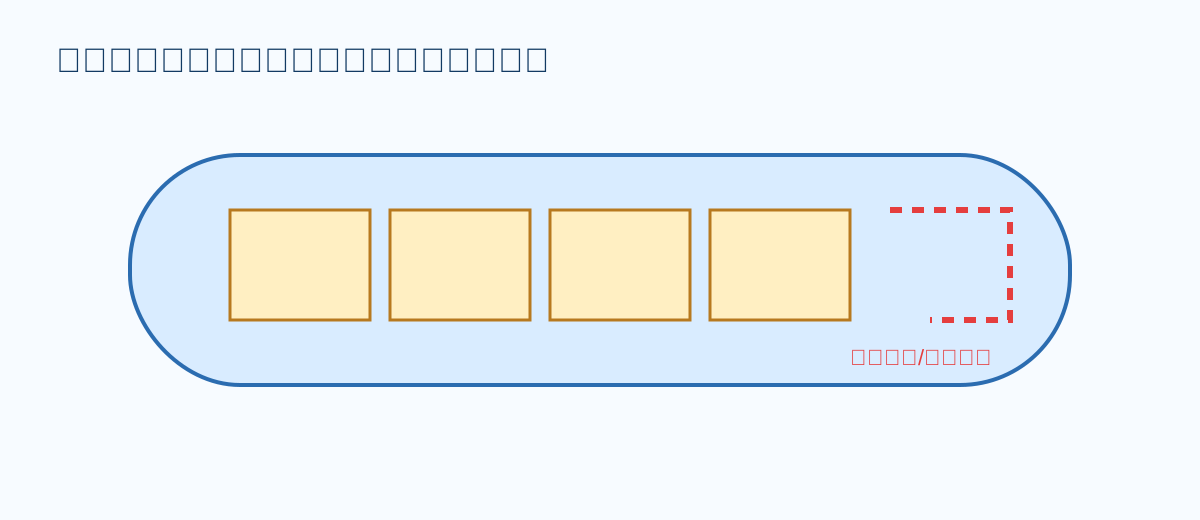
Maximum Cargo Hold Loading vs. Safety Margins
What Is a Safety Margin?
Safety clearance is not a waste of space; rather, it ensures that cargo can be safely loaded, secured, inspected, and unloaded without compromising the aircraft’s structure or systems during flight.
Types of Safety Clearance
Purpose
Contour Clearance
Prevents contact with the cargo compartment ceiling and side walls
Operational Clearance
Provides operating space for personnel, equipment, and roller beds
Securing Clearance
To ensure nets, straps, and buckles function properly
Temperature-controlled clearance
Maintain airflow circulation
Isolation Clearance
Distance required for hazardous materials, live animals, and temperature-controlled cargo
Emergency clearance
To facilitate inspection of anomalies and unloading
Packing the cargo tightly does not equate to high loading efficiency. Air cargo operations prioritize safety, controllability, and clearance.
Why Can’t We Load Cargo Even When There Appears to Be Space?
Reasons
Explanation
Loading capacity is full
Volume is not full, but weight is
Center of gravity does not allow it
Loading more would affect front-to-rear balance
A specific pallet position is unavailable
Restrictions due to latches, flooring, or equipment
Outline exceeds limits
Narrows at the top; cannot be placed flush against the edge
Special cargo isolation
Dangerous goods, live animals, and temperature-controlled cargo must not be placed in close proximity
Unloading sequence at the destination port
Overloading may prevent successful unloading
This is also the difference between air and ocean container loading. In ocean freight, the term “stuffing the container” is commonly used, but this “stuffing” mentality does not apply to air freight.
The Relationship Between Maximum Loading and Balance
An aircraft’s load balance depends on total weight, fore-and-aft weight distribution, fuel, range, airport conditions, and weather. Even if there is space left in a specific pallet position, it cannot be loaded if doing so would cause the center of gravity to exceed the permissible range.
Balancing Factors
Impact
Forward/Rear Cargo Bay Weight
Affects Center of Gravity
Left-Right Distribution
Affects Structure and Operation
Fuel Load
Long-range flights require more fuel, which can affect payload capacity
Weather and Temperature
High temperatures and high altitudes may limit payload
Runway Conditions
Heavy-load takeoff capability is limited
Cargo characteristics
Restrictions on the placement of special cargo
Therefore, for the same aircraft and the same shipment, loading capacity may vary depending on the route, weather conditions, and fuel load.
Why Freight Forwarders Should Be Conservative in Their Quotes
If a freight forwarder sells the entire theoretical cargo capacity to a client, the flight is likely to end up overloaded. A professional quote should allow for operational flexibility, especially when handling light-bulk cargo, e-commerce shipments, irregularly shaped cargo, and consolidated shipments from multiple consignments.
Cargo Type
Key Points to Note
E-commerce Boxed Cargo
Outer box deformation, dimensional discrepancies
Light and Bulky Cargo
Package Fills the Space but Is Underweight
Heavy Cargo
Floor Load and Load Balancing
Hazardous materials
Segregation and Labeling
Live Animals
Ventilation and Care
Temperature-Controlled Cargo
Airflow and Cargo Space
When quoting, you may say “estimated capacity,” but do not readily promise “guaranteed full load.” The final outcome of air cargo loading depends on the airline’s on-site confirmation.
Maximum Loading Procedure Chart
Stage
What to Check
Risk
Pre-loading
Cargo volume, weight, and dimensions
Inaccurate Data
Palletizing
Outline, netting, labels
Out-of-gauge
Airline acceptance
ULD, documentation, special cargo
Rejected
Loading Plan
Cargo Hold, Pallet Positions, Trim
Cargo Offload
On-site Loading
Equipment, Locking Mechanisms, Aisles
Temporary Adjustments
Release
Load balancing and unit verification
Load Limit
Each step can affect “how much more can be loaded.”
How to Reduce the Risk of Unloading Cargo
Report accurate cargo data in advance;
Do not underreport volume and weight;
Balance light, bulky cargo with heavy cargo;
Confirm in advance that special cargo will be segregated and assigned specific space;
Leave some headroom when approaching cargo capacity limits;
Communicate priorities in advance when airlines impose last-minute load restrictions;
For shipments split into batches by the customer, clearly identify which ones must be shipped immediately and which can be delayed.
If you’re booking a block space, you can first use OneCargoKit’s Chargeable Weight Calculator to estimate the chargeable weight for different cargo type combinations, then use the ULD Calculator to perform an initial loading assessment.
Common Misconceptions
Misconception 1: Cargo space confirmation guarantees that the cargo will be loaded.
Final loading depends on weight and balance considerations and on-site conditions.
Misconception 2: Cargo can be loaded as long as there is space in the hold.
Space is only one factor; weight and center of gravity are equally critical.
Misconception 3: The more lightweight cargo, the better.
Light, bulky cargo may fill the space but fail to meet the revenue weight requirement.
Misconception 4: Safety clearance is a waste of space.
This space is reserved for handling, securing cargo, ventilation, and safety.
Misconception 5: Cargo rejection is always the airline’s fault.
Inaccurate customer data, changes in cargo type, and weather-related load restrictions can all lead to cargo being offloaded.
Checklist
[ ] Cargo dimensions and weight have been verified
[ ] Stacked and compressed loading compatibility has been confirmed
[ ] Special cargo codes and segregation requirements have been confirmed
[ ] Cargo space estimation includes a safety margin
[ ] A reasonable mix of light and bulky cargo and heavy cargo has been achieved
[ ] Customer priority has been confirmed
[ ] Carrier load limits and cargo rejection clauses have been communicated
[ ] Unloading sequence at the destination port is feasible
Why an E-commerce Charter Flight Wasn’t Fully Loaded
A freight forwarder secured a wide-body freighter charter for e-commerce shipments. The client had declared 90 metric tons of billable weight. Upon arrival at the warehouse, however, it was discovered that the outer packaging dimensions were larger than expected, the proportion of light-bulky cargo was high, and many boxes could not be stacked tightly.During palletizing, the available space filled up quickly, but the actual gross weight and billable weight fell short of expectations. The client asked, “Isn’t there still load capacity left? Why not keep loading?”
The answer is: The volume capacity was already full, the aircraft’s external dimensions were nearing the limits, and the safety margins and operational space could not be further reduced. Just because the aircraft still has weight capacity does not mean there is still usable space.
Forecast
Actual
Estimated based on average box dimensions
Multiple SKUs with significant size variations
Expected to be stackable
Some shipments cannot be compressed
Billing weight appears sufficient
Actual cargo space fills up first
Believed there was still loading capacity
Outline and volume are already restricted
The biggest concern with e-commerce charter flights is inaccurate advance notifications. Changes in box specifications, bulging outer packaging, non-compressible cargo, and label orientation requirements can all affect actual loading.
How to Explain Safety Margins to Customers
Customers cannot see the load-balancing software or loading manuals; they only see that “there seems to be space left in the cargo hold.” You can explain this in more intuitive terms:
An aircraft cargo hold is not a shipping container. The remaining gaps may be for operational space, securing cargo, or airflow—or they may exist because weight and center of gravity constraints prevent further loading. We do not load cargo based on visual gaps, but rather according to load balance, dimensional limits, and safety constraints.
Customer Questions
Explanation Points
Why is there still empty space?
It could be due to safety margins or weight and balance restrictions
Why can others load more?
Different cargo types, aircraft models, routes, and weather conditions
Can we squeeze it in a bit?
Air cargo cannot be handled by simply cramming more in
Who is responsible for cargo rejection?
It depends on the forecast, delivery schedule, airline load limits, and contract terms
How can we improve cargo hold utilization?
Methods
Notes
Standardize container specifications in advance
Minimize waste from palletizing
Optimize the Mix of Heavy and Bulky Items
Balancing Weight and Volume
Cargo Classification
Separate time-sensitive shipments from those that can be delayed
Accurate Forecasting
Avoid Airlines Loading Based on Incorrect Data
Optimize Packaging
Reduce Unnecessary Bulk
Allow for Margin
Prevent critical failures
Improving utilization isn’t about cramming cargo in; it’s about optimizing from the very beginning—starting with cargo design, packaging, forecasting, and palletization.
The “Discipline of White Space” in Full-Container Load Operations
The most common mistake made by freight forwarders operating on a block space basis is selling every voyage to capacity in order to boost short-term revenue. While this yields high revenue in the short term, it leads to numerous issues in the long run: cargo rejection, rework, customer complaints, strained relationships with airlines, warehouse overtime, and chaotic financial reconciliations.
Overselling
Consequences
Failure to Allow for Volume Margin
Even slight changes in cargo dimensions can cause the warehouse to reach capacity
No Weight Buffer
No buffer when airlines impose weight limits
Failure to Prioritize Customers
Significant disputes arise when cargo is offloaded
No distinction made between cargo types
Imbalance in the mix of light, bulky cargo and heavy cargo
No written terms
Customers consider the freight forwarder to be in breach of contract
A mature block space operation establishes safety margins for each voyage. Not all available space is sold, nor are the same commitments made to every customer. The busier the season, the more essential it is to maintain this discipline of reserving capacity.
How to Conduct a Post-Discharge Review
A cargo rejection cannot be resolved simply by attributing it to “airline reasons” during the post-incident review. We recommend examining five key questions: Was the customer’s advance booking information accurate? Were warehouse remeasurements and reweighings conducted in a timely manner? Was the cargo mix appropriate? Did the airline impose last-minute load restrictions? Were the sales terms clearly communicated in advance?
The purpose of the review is not to assign blame, but to minimize similar issues in the future. True competence in air freight lies in turning exceptions into standard operating procedures (SOPs).
How to Turn Safety Margins into Rules Customers Can Accept
If safety margins are discussed only internally, customers may perceive it as an attempt to load less cargo. A better approach is to clearly state the following in quotations and booking confirmations: The estimated loading volume is based on the customer’s forecast data; the final volume is subject to actual re-measurement and re-weighing of the cargo, the carrier’s load planning, and on-site loading conditions;If the airline adjusts the load due to weather, weight limits, balance requirements, safety, or regulatory reasons, the freight forwarder will assist with rebooking but does not guarantee full loading unconditionally.
Terms
Purpose
Actual cargo prevails
Prevents inaccurate customer forecasts
Final loading on the aircraft shall prevail
Respect airlines’ safety authority
Explanation of Blank Spaces
Explanation of why the aircraft cannot be fully loaded
Priority Rules
Minimizing Disputes During Cargo Offloading
Rerouting Plan
Provide Customers with Next Steps
Customers can accept restrictions, but they find it hard to accept them when they’re only informed at the last minute. Explaining things clearly in advance actually makes it easier to build trust.
How Freight Forwarders Manage Priorities Internally
When consolidating shipments from multiple clients on chartered space or chartered flights, priorities must be defined in advance: which shipments have strict time-sensitive requirements and which can be delayed; which clients have purchased guaranteed space and which are on the waiting list; and which shipments, if dropped, would disrupt production lines versus those that are simply routine restocking.
Without clear priorities, decisions on which shipments to drop will become ad-hoc and arbitrary. The busier the season, the more crucial it is to document these priorities in the operations schedule.
How to Demonstrate the Value of “Breathing Room” to Clients
The best approach is not to argue, but to demonstrate with data. For example, list the forecasted billable weight, actual billable weight, available space, occupied space, airline load limits, and details of any cargo that was offloaded. When clients see the data, they will understand that this is not a subjective refusal to load, but rather an objective constraint.
Data
Role
Difference Between Forecast and Actual
Explains why the plan changed
Pallet Space Utilization
Display Space Occupancy
Weight Utilization
Display of Load Limits
Airline Load Limit Notices
Documentation of External Restrictions
Priority for Offloading
Reduce Disputes
The more transparent air cargo management is, the more readily customers will accept restrictions. Leaving capacity unused is not a loss; it is a safety margin that ensures stable flight operations.
The Final Management Step
We recommend recording the actual load factor, reasons for cargo rejection, discrepancies in customer forecasts, and airline restrictions after each charter flight. After a few months, you’ll discover that what truly impacts profitability isn’t the price of a single shipment, but whether long-term load data is manageable. Only teams that review their performance will become increasingly skilled at optimizing load planning.
Once this data is established, sales quoting, customer screening, and cargo mix optimization will all become more stable.
Air freight is not a one-time transaction; long-term, stable capacity management relies on this ability to review and analyze. Being able to clearly explain why a flight cannot be fully loaded is also a form of professional service.
Ultimately, customers aren’t buying a “full load”—they’re buying a flight that departs as scheduled.
Consistent, on-schedule departures are the greatest value of air freight.
That little bit of empty space is often a purchase of safety.
Safety margins must not be traded for short-term revenue.
This must be written into the SOP.
And it must be consistently enforced.
Professional Summary
Filling an aircraft’s cargo hold to capacity isn’t necessarily the best approach; rather, it’s about striking a balance between safety, profitability, and operational feasibility. Just because it appears to fit doesn’t mean the rules allow it; just because there’s space left doesn’t mean the weight and center of gravity limits still permit it.
For freight forwarders, true professionalism lies not in selling cargo space to the absolute limit, but in knowing when to leave space. Safety margins are not a loss; they are insurance against even greater losses.
This article is intended as industry knowledge and a practical reference; it does not constitute advice on aircraft loading or flight safety. For specific loading restrictions, weight and balance requirements, and space-reservation guidelines, please refer to the airline’s Weight and Balance Manual, as well as the approvals from ground handlers and flight crews.