Disclaimer — This article is provided as general logistics industry knowledge and practical reference only. It does not constitute aviation safety, dangerous goods carriage, legal, tax or other professional advice. Actual transport, declaration, packaging, loading and customs requirements are subject to the carrier, competent authorities, official regulations and professional advice.
Many newcomers to air freight assume that “loading the pallet” simply means placing cargo onto a pallet. Anyone who has actually worked on a main-deck cargo aircraft knows that a cargo pallet is not just an ordinary pallet—it is part of the aircraft’s safety system.The pallet type, netting, dimensions, locking mechanisms, airworthiness status, and the aircraft cargo compartment envelope all determine whether a shipment can be loaded onto the plane.
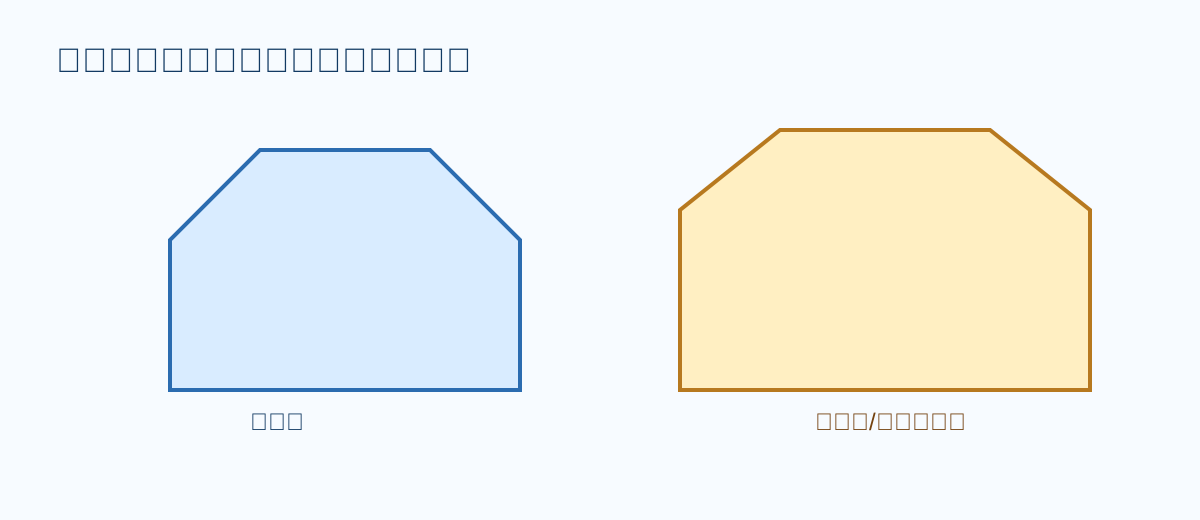
Schematic of an Air Cargo Pallet Outline
ULDs Are Not Packaging Materials, but Aircraft Components
IATA’s definition of ULDs is clear: ULDs are unit load devices, including air cargo pallets with netting or air cargo containers. IATA also emphasizes that ULDs are removable aircraft components subject to strict airworthiness requirements. Airworthy ULDs must be capable of securing the load and protecting the aircraft’s systems and structure.
This point is particularly important for freight forwarders. Many freight forwarders, manufacturers, and warehouses treat ULDs as “large pallets borrowed for use,” which is very dangerous.
Standard Pallets
Airway Pallets
Primarily used for warehousing and handling
Contribute to flight safety
Damage has limited impact
Damage may affect airworthiness
May not have a standard number
Has a ULD ID and meets airworthiness requirements
May be reinforced as needed
Must comply with airline and IATA regulations
Understanding Common Air Cargo Pallets
Different airlines, aircraft types, and markets use different ULDs. Freight forwarders often hear terms like PMC, PAG, and PLA. Specific compatibility depends on the carrier’s rules; the table below is provided solely for practical understanding.
Panel Type
Common Understanding
Typical Uses
PMC
Common 96 x 125-inch air cargo pallet
Widely used on main decks and in lower holds, depending on aircraft type and profile
PAG
Common 88 x 125-inch air cargo pallets
Commonly used on wide-body aircraft; positioning and height restrictions vary
PLA
Larger-sized cargo pallets
Used on some cargo aircraft or in specific scenarios
P6P/P1P, etc.
Pallet types in IATA/industry codes
Depends on the airline and aircraft type
Beginners should not just memorize pallet names; instead, they should understand three key points: pallet dimensions, available clearance, and aircraft compatibility.
The profile is more important than length and width
Whether cargo can be loaded depends on more than just the base plate’s length and width. The aircraft fuselage has a circular cross-section that tapers toward the top. The taller the cargo, the more restricted the available width becomes.
Factors to Consider
Meaning
Base size
Base Dimensions
Contour
Permissible contour after loading
Height limit
Height limit
Overhang
Does the cargo extend beyond the edge of the deck?
Net compatibility
Does the netting match the height and shape?
Aircraft Acceptability
Is this pallet type/contour accepted by the aircraft model?
IATA ULDR requirements include aircraft contour drawings, pallet/net compatibility, and ULD serviceability checks. In actual operations, when cargo is close to the contour boundaries, confirmation from the airline is required.
Why Can’t We Judge Oversized Cargo Based on Panel Length Alone?
Some cargo items are longer than standard pallets and require cross-pallet, overhang, or special loading arrangements. Handling oversized cargo is not simply a matter of joining two pallets together.
Risks
Explanation
Support Between Pallets
Is the cargo weight distributed appropriately?
Mid-span overhang
Long items may deform under stress
Matching of locking clips
Are there sufficient restraint points behind the cross-braces?
Entry angle
Can long items pass through the cargo door and navigate turns?
Floor load
Does the weight distribution exceed limits?
Unloading at the destination port
Availability of equivalent equipment at the destination port
For oversized cargo, it is best to provide a diagram of the bottom structure. Simply stating “6 meters long, 3 metric tons” is far from sufficient for operational purposes.
Pallet Selection Process
Stage
Action
Output
1. Verification of Cargo Dimensions
Measure length, width, and height, including packaging
Actual Dimensions
2. Verification of Cargo Weight
Weight per piece, total weight, and center of gravity
Load Assessment
3. Preliminary selection of pallet type
Based on pallet dimensions and aircraft type
Candidate ULDs
4. Outline Verification
Check height, width, and curved tapers
to determine if they exceed the outline
5. Net/Securing Assessment
Determine if it can be tied or restrained
Fastening Plan
6. Airline Confirmation
Review based on aircraft type and flight restrictions
Final Loadability
You can use OneCargoKit’s ULD Calculator for preliminary screening. Especially when imperial and metric dimensions are mixed, use the Unit Converter to standardize units first, then discuss pallet configurations.
Common Scenarios for Pallet Compatibility
Scenario
Recommendations
Standard Box Trucks
Standard pallet sizes are sufficient, but check the height
Lightweight E-commerce Cargo
Focus on the outline and volume utilization
Heavy machinery
Focus on point loads and dunnage
Extra-long cargo
Consider cross-bracing, overhangs, and entry angles
Fragile Cargo
Check whether they can be stacked and whether isolation is required
Hazardous Materials
Check for loading segregation and airline regulations
Different types of cargo have different requirements for “pallets.” E-commerce cargo prioritizes cubic utilization; heavy cargo prioritizes load distribution; dangerous goods prioritize isolation and identification; and oversized cargo prioritizes route verification.
Common Misconceptions
Misconception 1: As long as the pallet is long enough, it can be loaded.
You also need to consider the cargo’s outline, locking mechanisms, the ULD floor, and the loading angle.
Misconception 2: A ULD is the freight forwarder’s own pallet.
ULDs are aircraft components; damage or non-airworthiness can compromise flight safety.
Misconception 3: It’s okay if the cargo slightly exceeds the limits.
Airline dimension restrictions are not like warehouse shelving—you can’t just squeeze the cargo in.
Misconception 4: You can just throw a netting over the cargo.
Netting must effectively secure the cargo and match the pallet type and height.
Misconception 5: The lower deck and main deck panels can be interchanged at will.
Applicable aircraft types, positions, and external dimensions depend on airline regulations.
Pre-Loading Checklist
[ ] Do the cargo dimensions include packaging and protrusions?
[ ] Have the weight and center of gravity of each piece been confirmed?
[ ] Is the cargo stackable, compressible, and tiltable?
[ ] Does the pallet type match the aircraft type?
[ ] Are the cargo dimensions within the allowed limits?
[ ] Are there sufficient netting, straps, and securing points?
[ ] Is the ULD airworthy, and are its serial number and status clearly identified?
[ ] Is a pallet inspection or airline engineering confirmation required?
Why Does Pallet Loading Quality Affect Flight Revenue?
Even for the same main deck cargo pallet, there is a significant difference in revenue between a well-loaded and a poorly loaded pallet. A well-loaded pallet features high space utilization, optimal weight distribution, neatly arranged netting, and quick airline acceptance; a poorly loaded pallet may exceed dimensional limits, have an off-center of gravity, use mismatched netting, or even require unloading and reloading.
Loading Quality
Impact on Flights
Reasonable Contour Utilization
Improves cargo hold utilization
Even weight distribution
Facilitates Trim
Clear labeling
Facilitates security screening and loading
Effective Restraints
Reduces flight risks
Airworthiness inspection complete
Reduces rejections
Freight forwarders handling palletized cargo must pay special attention to palletizing quality. You’re purchasing a block of space, and how that space is utilized determines your gross profit.
How do freight forwarders determine whether a warehouse will load pallets correctly?
Key Considerations
Signs of a Good Warehouse
Familiarity with ULD Types
Can clearly explain pallet configurations, netting, and compatible aircraft types
Do they perform airworthiness inspections?
Inspects panels, netting, and edge rails before panel assembly
Do you understand the cargo profile?
Do not force cargo to exceed dimensional limits
Can handle heavy cargo
Understand the requirements for dunnage and load distribution
Do you keep records?
There are records of photos, dimensions, weights, and anomalies
If the warehouse only says, “We’ve always packed it this way,” but cannot clearly explain the ULD number, dimensions, netting, and airworthiness inspection, proceed with caution.
A common mistake: applying container loading logic from ocean freight to air freight
Sea freight container loading aims to pack as much as possible, while air freight palletization aims to utilize space within the regulations. The logic behind the two is different.
Sea Freight Container Loading
Air Cargo Palletizing
Containers are transport vessels
ULDs are aircraft components
More filler material can be used
Subject to dimensional and airworthiness restrictions
Focus primarily on securing and preventing shifting
Load balance and aircraft type must also be considered
Ample room for on-site adjustments
Strict flight cut-off times and acceptance procedures
If a factory manufactures oversized wooden crates based on ocean freight standards, the packaging will likely need to be modified upon arrival at the air cargo warehouse. The best approach is to involve the freight forwarder during the packaging design phase.
How to Explain Pallet Pricing to Clients
Customers often ask, “Why is there such a big price difference between shipments of the same weight but different dimensions?” You can explain it this way: Air freight isn’t just about weight—it’s also about space and dimensions.A 500 kg light-bulk shipment might take up half a pallet, while a 2,000 kg heavy shipment might occupy only a small area but require dunnage and a special location. Pricing depends on weight, volume, dimensions, handling complexity, and airline restrictions.
Using OneCargoKit’s Chargeable Weight Calculator to show clients the volumetric weight is more intuitive than a verbal explanation.
Why does the pallet type change when the aircraft type changes for the same shipment?
Customers often ask, “This shipment was loaded on this pallet last time—why won’t it work this time?” The reason may be changes in aircraft type, airline, route, pallet position, dimensions, or ULD availability.Even for the same PMC, the available configurations may not be exactly the same across different aircraft types, cargo holds, or height profiles.
Factors Affecting Configuration
Impact
Different Aircraft Types
Different cargo hold profiles
Different airlines
Different ULD Acceptance Rules
Different Loading Positions
Different height and weight limits
Different netting
Different cargo securing capabilities
Different routes
Different payload and fuel requirements
Same-day ULD availability
Limited available ULD types
Therefore, while historical experience is valuable as a reference, it cannot replace confirmation for the specific shipment. The best response a freight forwarder can give a client is: “We can use the previous plan as a reference, but this shipment still needs to be confirmed based on the actual flight and ULD status.”
How to Improve Loading Efficiency Through Cargo Packaging
Standardizing box dimensions as much as possible, avoiding unnecessary protrusions, marking items as crushable or non-crushable, clearly indicating the center of gravity and lifting points, ensuring the strength of outer packaging, and aligning label orientations can all significantly improve loading efficiency.Air cargo loading is not the final step in the warehouse process; it should begin with packaging design. Major clients with expertise in air freight will design box specifications, pallets, labels, and loading methods as an integrated process.
How to Apply ULD Knowledge to Sales Quotations
Sales representatives do not need to memorize all ULD codes, but they should at least be able to determine whether “this shipment is priced by weight or by pallet space.” For light-bulk cargo, the cost often lies not in weight but in space occupancy; for heavy cargo, the cost often lies not in volume but in load capacity and handling. Explaining this clearly makes it easier for customers to accept price differences.
Customer Questions
Explanation Points
Why is it so expensive for just a few hundred kilograms?
It may occupy a significant amount of space and have an irregular shape
Why is there a pallet fee?
There are costs associated with ULDs, mesh fixtures, labor, and inspection
Why can’t I stack one more layer?
It might exceed the outline, cause damage, or affect securing
Why did the price change when I switched flights?
Aircraft type and ULD availability may vary
When providing a quote, it’s best to show the customer the dimensions, weight, chargeable weight, and estimated space occupancy. This way, the customer understands they’re purchasing airspace, not just a specific weight in kilograms.
Packaging Recommendations for Warehouses and Factories
If a factory frequently ships by air, it can make packaging more “air-friendly”: standardize box dimensions, ensure flat bottoms, provide sufficient strength, use clear labeling, clearly mark non-compressible cargo, and indicate the center of gravity and lifting points in advance. Warehouses should also have a system for remeasuring and reweighing cargo when loading pallets; do not rely entirely on the customer’s advance declaration.
The goal of air freight packaging is not to make it as sturdy as possible, but to protect the cargo while minimizing unnecessary dimensional waste. Every extra 5 centimeters can prevent a shipment from fitting within the main deck’s outline.
How to Train the Team on Palletization Awareness
We recommend that freight forwarders compile an internal handbook featuring common pallet configurations, outline diagrams, aircraft type restrictions, and typical case studies. Sales representatives do not need to become loading engineers, but they must be able to understand why a client’s cargo occupies a pallet, why it exceeds the outline, and why an aircraft type change is necessary. Operations staff, meanwhile, must be able to translate airline requirements into language that clients can understand.
The sooner palletization awareness is established, the more accurate the quotes will be, and the fewer exceptions there will be. This is especially true for charter teams, which should regularly review the loading results for each flight: which cargo types are highly efficient to palletize, which customers’ container specifications waste space, and which packaging is prone to exceeding the outline. With frequent reviews, they will build their own database of palletization experience.
One final practical tip
Your palletization experience database directly impacts the speed of your next quote and space utilization. Documenting the results of every palletization session is more reliable than asking others on the spot.
Professional Summary
Selecting air cargo pallets essentially involves matching the cargo’s shape, weight, and securing methods with the aircraft cargo hold’s envelope. The real risk lies not in “whether a pallet is available,” but in “whether this specific pallet, with this outline, in this position, on this particular aircraft, is acceptable.”
The sooner freight forwarders and clients understand the airworthiness attributes of ULDs, the less likely they will treat air cargo loading as if it were simply palletizing in a regular warehouse. The safety margins in air transport are not achieved by forcing cargo into ULDs based on experience alone, but are established through rules, inspections, and verification.
This article is intended as an industry knowledge and practical reference and does not constitute advice on aviation safety, ULD maintenance, or loading operations. For specific ULD types, outlines, netting, and aircraft model compatibility, please refer to the requirements of the airline, IATA ULDR, and ground handling agents.